Kiddush – Friday night (Erev Shabbat)

Friday night erev shabbat (short-long-reanslation)  – Printable version

==============


The shorte Firday night Kidush version – like the one seen in the tutorial

בָּרוּךְ אַתָּה ה’. אֱלהֵינוּ מֶלֶךְ הָעולָם בּורֵא פְּרִי הַגָּפֶן

בָּרוּךְ אַתָּה ה’ אֱלהֵינוּ מֶלֶךְ הָעולָם. אֲשֶׁר קִדְּשָׁנוּ בְּמִצְותָיו וְרָצָה בָנוּ.
וְשַׁבַּת קָדְשׁו בְּאַהֲבָה וּבְרָצון הִנְחִילָנוּ.
זִכָּרון לְמַעֲשֵׂה בְרֵאשִׁית.
כִּי הוּא יום תְּחִלָּה לְמִקְרָאֵי קדֶשׁ זֵכֶר לִיצִיאַת מִצְרָיִם.
כִּי בָנוּ בָחַרְתָּ וְאותָנוּ קִדַּשְׁתָּ מִכָּל הָעַמִּים וְשַׁבַּת קָדְשְׁךָ בְּאַהֲבָה וּבְרָצון הִנְחַלְתָּנוּ:
בָּרוּךְ אַתָּה ה’. מְקַדֵּשׁ הַשַּׁבָּת

Baruch Atah Adonai, Eloheinu Melech Ha-olam, Borei Pri Hagafen. 
Baruch Atah Adonai, Eloheinu Melech Ha-olam, Asher 
Ki-d’shanu B’mitzvotav 
V’ratzah Vanu, V’Shabbat Kodshoh, B’ahavah Uvratzon Hinchilanu Zikaron L’ma-asei V’reishit. Ki Hu Yom T’chillah L’mikra-ei Kodesh, Zeicher 
L’tzi-at Mitzrayim. Ki Vanu Vacharta V’otanu Kidashta 
Mikol Ha-amim, V’Shabbat Kodsh’cha B’ahavah Uvratzon Hinchaltanu. 
Baruch Atah Adonai, 
M’kadeish HaShabbat.


Friday Night Kiddush – The full version

יום השישי. וַיְכֻלּוּ הַשָּׁמַיִם וְהָאָרֶץ, וְכָל-צְבָאָם.

וַיְכַל אֱלקִים בַּיּוֹם הַשְּׁבִיעִי, מְלַאכְתּוֹ אֲשֶׁר עָשָׂה;
וַיִּשְׁבֹּת בַּיּוֹם הַשְּׁבִיעִי, מִכָּל-מְלַאכְתּוֹ אֲשֶׁר עָשָׂה.
וַיְבָרֶךְ אֱלֹקִים אֶת-יוֹם הַשְּׁבִיעִי, וַיְקַדֵּשׁ אֹתוֹ:
כִּי בוֹ שָׁבַת מִכָּל-מְלַאכְתּוֹ, אֲשֶׁר-בָּרָא אֱלֹקִים לַעֲשׂוֹת. 

סַבְרִי מָרָנָן וְרַבָּנָן וְרַבּותַי:
בָּרוּךְ אַתָּה ה’. אֱלהֵינוּ מֶלֶךְ הָעולָם בּורֵא פְּרִי הַגָּפֶן:

בָּרוּךְ אַתָּה ה’ אֱלהֵינוּ מֶלֶךְ הָעולָם. אֲשֶׁר קִדְּשָׁנוּ בְּמִצְותָיו וְרָצָה בָנוּ.
וְשַׁבַּת קָדְשׁו בְּאַהֲבָה וּבְרָצון הִנְחִילָנוּ.
זִכָּרון לְמַעֲשֵׂה בְרֵאשִׁית.
כִּי הוּא יום תְּחִלָּה לְמִקְרָאֵי קדֶשׁ זֵכֶר לִיצִיאַת מִצְרָיִם.
כִּי בָנוּ בָחַרְתָּ וְאותָנוּ קִדַּשְׁתָּ מִכָּל הָעַמִּים וְשַׁבַּת קָדְשְׁךָ בְּאַהֲבָה וּבְרָצון הִנְחַלְתָּנוּ:
בָּרוּךְ אַתָּה ה’. מְקַדֵּשׁ הַשַּׁבָּת:

Yom Hashishi. Va-y’chulu Hashamayim 
V ’ha-aretz V’chol Tzva-am. 
Va-y’chal Elohim Bayom Hash’vi-i M’lachto Asher Asah, Vayishbot Bayom Hash’vi-i Mikol M’lachto Asher Asah. Vay’vareich Elohim Et Yom Hash’vi-i Va-y’kadeish 
Oto, Ki Vo Shavat Mikol M’lachto, Asher Barah Elohim La-asot. 
Savri Maranan V’rabanan V’rabotai 
Baruch Atah Adonai, Eloheinu Melech Ha-olam, Borei Pri Hagafen. 
Baruch Atah Adonai, Eloheinu Melech Ha-olam, Asher 
Ki-d’shanu B’mitzvotav 
V’ratzah Vanu, V’Shabbat Kodshoh, B’ahavah Uvratzon Hinchilanu Zikaron L’ma-asei V’reishit. Ki Hu Yom T’chillah L’mikra-ei Kodesh, Zeicher 
L’tzi-at Mitzrayim. Ki Vanu Vacharta V’otanu Kidashta 
Mikol Ha-amim, V’Shabbat Kodsh’cha B’ahavah Uvratzon Hinchaltanu. 
Baruch Atah Adonai, 
M’kadeish HaShabbat.


Translation

And it was evening, and it was morning. The sixth day. Then the heavens and the earth were completed, and all their array. With the seventh day, G-d completed the work He had done. He ceased on the seventh day from the work He had done. G-d blessed the seventh day and called it holy, because on it He ceased from all His work He had created to do. Please pay attention, my masters. Blessed are You, Lord our G-d, King of the Universe, Who creates the fruit of the vine. Blessed are You, Lord our G-d, King of the Universe, Who has made us holy through His commandments, Who has favoured us, and in love and favour gave us His holy Sabbath as a heritage, a remembrance of the work of Creation. It is the first among the Holy Days of assembly, a remembrance of the Exodus from Egypt. For You chose us and sanctified us from all the people, and in love and favour gave us Your Holy Sabbath as a heritage. Blessed are You, Lord, who sanctifies the Sabbath.



Shmita – Jewish Economic Laws of ‘Capitalism with a Social Net’ (‘Beth Israel Synagogue’ bulletin, High Holidays 5775)

trees photo

shimta

Money makes the world go round, and round, and round. Viewing it in perspective
leads to the inevitable conclusion that anything that accelerates needs an inhibiter to
balance it, because just like the world itself, people too, very often find themselves
going round. Once you’re on top, often you might find yourself glancing upward from
the bottom.
A responsible economic system should see to it that those on the top are sensitive and
helpful to those who are less fortunate. That has to be done without giving those on
top the feeling that are being taken advantage of and without making it shameful to be
rich.
Easy to say, difficult to carry out, especially since those who command such economic
systems have their own interests which usually differ from those who are at the
bottom…
Well, the One who wrote the laws of the Torah does not have to secure His own
materialistic investments with complicated rulings. All is His. And His is all. Rich and
poor are the same in His eyes. He is equally concerned for all.
One who has much property can he, with a hand over his heart, honestly testify that he
achieved more than his competitors/peers because of sheer talent? Those who have
experienced both sides of the wheel of fortune know, more than others, that it is just
that… a wheel of fortune. There is no clear formula that can calculate how much talent
and hard work lead to absolute fortune. What more than the word “fortune” itself to
make our point clear. Can one say that material achievements are totally a result of
pure luck or chance? Of course not!
Yet in a place and era that emphasizes the exact opposite, that hard work and talent
lead to prosperity, it is sometimes necessary to remind ourselves of our limitations. We
need to look around and see the complexity of the world and teach ourselves some
humility.
Moreover, like everything else in Judaism, no novelty is ever confined within the
boundaries of the idea. Every teaching has consequences to be implemented for the
benefit of humankind.
Where on Earth do we start?
That’s where the laws of Shmita (Sabbatical) enter our lives, entering very shortly, at
the start of Rosh Hashanah.What is Shmita all about?
For 7 years we tend to our business as usual. One can buy, sell, lend, hire, anything
allowed in any capitalistic economy, albeit with the specific “balancing” including Mitzvot
such as Tzdakah, tithes and lending without interest etc.
But the big boom kicks in at the 7th year- the year of Shmita. Shmita means that all
properties are released and returned to their original owners. 7 years is the maximum
time span you have to conduct business using your property. At the 7th year, everyone
goes back to ground level zero. This way, no one remains forever groundless. A fresh
beginning; a new start. That is what Shmita is all about.
However, there is more to Shmita than the territorial transactions that can only apply in
our real land, Israel. Another aspect of Shmita comes into play at the end of the 7th
year. It is called Shmitat ksafim’ (money drop)
What is that all about?
It is quite an astonishing idea. All loans are cancelled at the end of the seventh year.
(The dates are predictable, every 7 years from the creation of the world until present
time, 5775). Every borrower should pay of their loans during those seven years. If they
don’t, there is an endpoint. Shmitat ksafim’. All loans become erased. What a wonderful
tiding for those who are in debt. Not so much for the lenders. So how can manipulation
be avoided?
Indeed about 2,100 years ago, at the conclusion of the second temple, there seemed to
be an economic crisis. The rich halted loans for fear of opportunists who would
manipulate Shmitat ksafim’ to increase their own fortunes, by taking loans with the
intention of not repaying them! This phenomenon impaired the country’s economy, but
even worse, the unfortunates, who relied on loans to just to survive bad times, found
themselves at a standstill.
Undoubtedly, this was not the Torah’s intention. Seeing this, Hillel Hazaken, who was
the head of the Sanhedrin at the time, applied Halachik tools entrusted to him by
traditional law, to correct this situation by reinforcing the original Torah values of
sympathy and charity. He installed the ‘prozbul’.
Prozbul, is a legal document (such as the ‘selling of the Chametz at Passover’), where
the lender gives the outstanding bill to the Bet Din (Jewish court). Thus, the debt
becomes de-personalized and therefore shmitat ksafim does not apply to it. The debt in
such a case will not be cancelled at the end of the seventh year.
Therefore if an opportunist borrows money in order to invest and grow his fortune
using others’ charitable inclinations – there is no reason to forgive this debt. The lender
could fill in the prozbul.At the onset, Hillel’s ordinance, that seemed to annul Torahs laws of Shmita, inevitably
became a way to strengthen the Torah’s spirit of Shmita in a beautiful way.
In reality, John Doe who is in a time of need, will make every effort to repay his debt,
because he doesn’t know if the lender completed a Prozbul or not. The lender on his
part will not be afraid to lend money to those who seek aid since he can write a
prozbul, and he has the opportunity to help a friend who stands needy, by NOT filling in
the prozbul. What a pleasant surprise for the borrower a the end of the seventh year!
Recently in the past few years, a very appropriate minhag started taking place. There
are people who come to local Rabbis / Bet Din to fill out the prozbul document and then
lend money to discretionary funds which they exclude from the Prozbul. By that, one
can accomplish two things…the Mitzvah of lending money to the poor as well as
tzedakah and the rabbinic fulfillment of shmita, the release of debts at the end of the
seventh year.
May we never meet at the receiving end. May we all merit the ability to bestow charity
and goodness at God’s will.
Shanah Tova from Avia, B’Naya, Rumya, Amichai and I,

Literary analysis of Psalm 27 – One thing I ask of Adonai

For the entire month of Elul, leading into Sukkot, this Psalm is traditionally read at both morning and evening services. Perhaps because its last stanza –“Hope in Adonai; be strong and of good courage!”`– may fortify those who recite it, as they face the Days of Repentance and Judgement. Perhaps because the first line of the song itself suggests both Rosh Hashanah and Yom Kippur: “Adonai is my light and salvation” — that quality of God recognized in Rosh Hashanah is light; that sought for in Yom Kippur, salvation

The metaphors of the first verse may allude to the predicament of the singer that he struggles with throughout the song: Adonai is his light and salvation, but also his stronghold  –the first qualities, light and salvation, are the elements of the heavens; the latter, stronghold, in contrast, suggests the physicality of earth. The singer, yearning for the heavens, must decide whether or not to reconcile himself with the earth and the anguish –abandonment (v. 10), enmity (verses 2, 3, 6, 11, 12)– it has caused him. Thus the song is inspired by the two locations or spaces, the heavens and the earth, and, along with them, by the two periods of time, present and future: surrounded by his foes, with seemingly no allies, he would escape both the present and the earth it binds him to, for a vision of a future in the heavens of God’s sanctuary.
Although he declares, in verses 2 and 3, that his “heart would have no fear” of the evildoers who would “devour” his “flesh”, for he is fortified by God, nonetheless verses 4 and 5 make clear the singer’s conflict. His desire to dwell in the heavens, his reality that he is solidly mired in the earth, sound out a verbal tug-of-war: the verbs of verse 4 are “dwell”, “behold”, “frequent”. Certainly “dwell” and “behold” can complement each other, but “frequent” is their counter. For “frequent” suggests a visit; “dwell”, a permanency. Both conditions cannot exist at the same time. And yet the one line of verse contains all three verbs, with no break indicating a change in point of view or perception:
                                                One thing I ask of Adonai; that is what I seek:
                                                to dwell in the house of Adonai all the days of my life,
                                                to behold the beauty of Adonai,
                                                to frequent His temple.*
Similarly, verse 5 asks that God “hide” the singer in “His pavilion”, “conceal” him in “His tent”, a request that is immediately contradicted
–again, without break or pause– by the addition, “raise [him] high upon a rock”: the two images of concealment, at once countered by an image of utter exposure. Moreover, the rock is distinctly an element of the earth, in complete contrast to the heavenly pavilion and tent of God.
Verse 6 continues the contradictory imagery, at once explaining that, elevated upon the rock, the singer will have advantage over his enemies, while, in the next phrase, declaring how he will “sacrifice in His tent with shouts of joy; [he] will sing and chant hymns to Adonai”. It would seem, then, as though the singer is standing with his feet on the rock and his head in the heavens. Part, that is, of both spaces but belonging wholly to neither.
Seeking God’s protection, the singer pleads “to behold the beauty of Adonai” (v. 4), to seek His face (verses 8 and 9). Again, his perception, his vision, is of the heavens, of God’s sanctuary, while his physical body, in turn, is under his enemies’ scrutiny.
Not until verse 11 does the singer come to a resolution, a reconciliation, within himself; ironically, the cause brought about by his foes**:
                                                  Show me, Adonai, Your way, 
                                                  and lead me on a level path
                                                  because of my watchful adversaries.
The level path is earth’s. Its necessity, to allow the singer to overcome his enemies. But it is level, without impediments, simply because it is God’s way. The singer will now place his feet on the firm ground, no longer seeking the elevation of the rock, sure that God will mark his path for him.
Verse 13 affirms the singer’s resolve –he must believe that earth will not be devoid of God’s presence, that, indeed, hewill “see Adonai’s goodness in the land of the living”. Only now is he able to accept his own place, to make his own dwelling, among the living. The last stanza proclaims his commitment, his credo and his purpose:
                                                   Hope in Adonai;
                                                   be strong and of good courage!
                                                   O hope in Adonai.
 
————————————————————————————————————————————————————————————
  * The temple was not built until King Solomon’s time, so the reference is to God’s imagistic one, not to the actual earthly structure.
  **The power and malevolence of the foes are revealed in the metaphor of their “breathing out violence” (v. 12). Violence is, then, a part      of their very being. Not imposed on them by outside forces, but, rather, their basic element.
https://www.youtube.com/watch?v=T3d6mdylfhU

HIGH HOLIDAYS SONGS – Preparations for the high holidays services at ‘The Beth Israel Synagogue’ – 5775

Shalom Chaverim,
Until the Beth’s website will be updated, please use this webpage, and get ready for the upcoming High Holidays services.
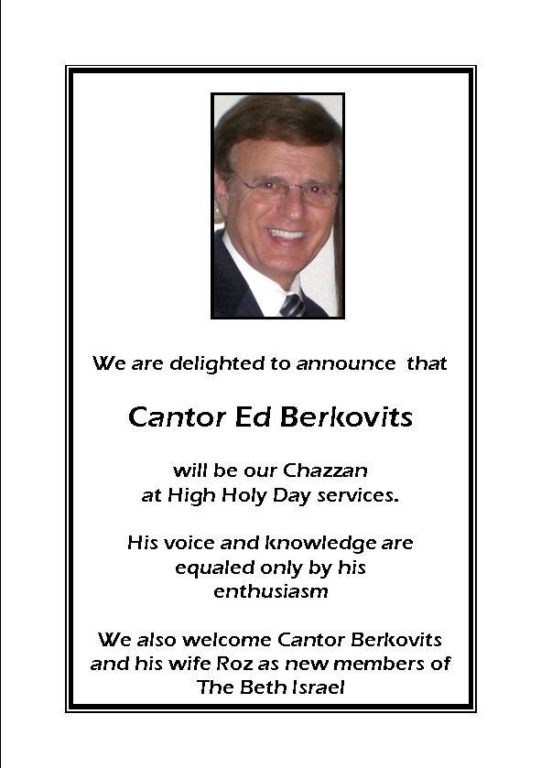
We are fortunate to have our old-new home cantor, Cantor Ed Berkovits, coming back to Halifax after serving several congregations in the U.S. (See Cantor Berkovits’s letter to the Beth Israel Family, below the tutorials).

BARUCH HOO UVARUCH SHEMO AMEN OSE SHALOM – אמן ברוך הוא וברוך שמו – עושה שלום במרומיו

ZOCHRENU LE CHAYIM n MECHALKEL CHAYIM זכרנו לחיים ו- מכלכל חיים בחסד

VENE’EMAR – וְנֶאֱמַר (year 5774)

KADESHENU BE-MITZVOTECHA – קַדְּשֵׁנוּ בְּמִצְותֶךָ (year 5774)

B ROSH HASHANA N MI MEKOMO – בראש השנה ו-ממקומו

HA BEN YAKIR LEE – הבן יקיר לי אפרים

ve chol maminim N simcha leartzecha וכל מאמינים ו- שמחה לארצך

VE KAREV PEZUREINU – וקרב פזורינו

U-VAOO HA-OVDIM – וּבָאוּ הָאֹבְדִים (year 5774)

ARESHET SEFATENU – ארשת שפתינו (year 5774)

ZIM (sim) SHALOM – שים שלום טובה וברכה

HAYOM TE AMETZENU – היום תאמצנו

Ein Kelohenu – אין כאלוהינו


Cantor Berkovits’s letter to the Beth Israel Family for Rosh HaShana 5775:Edd Berkovits - Beth Israel Halifax cantor

It is a pleasure to be back in Halifax as your High Holiday cantor.  As members
of Beth Israel, Roz and I look forward to assisting the congregation as volunteers when
we are in town.
     For those who do not know, this was my first position as a professional cantor. Just
a quick review, in case you were wondering where we have been since leaving in
1971. I have been a cantor in all these cities: Halifax, Pittsfield, Omaha, Orlando,
where our son David was born,Charleston, where our son Adam was born, Cleveland,
Syracuse, Palm Beach Gardens, Coconut Creek, Boca Raton, Long Island and
Boynton Beach.
     Roz and I look forward to spending our first Yom Tov in 44 years at the Beth with our family and friends, old and new.  I think that it  is amazing to be able to complete my career here, where it first began.
       Wishing you all a Shana Tova umetuka. See you in shul and …remember to sing
along


Literary analysis of Psalm 20

The structure of Song 20 has a precise symmetry: the 10 verses divide into two equal parts; the name Adonai is repeated 5 times. In contrast, the content is a labyrinth, puzzles within puzzles. The first puzzle presents itself immediately: verse 1 identifies the composer of the song as David. But what is not made clear is whether or not his is the voice speaking throughout the verses, and even more unclear is who the person is that he is speaking to. The “you” addressed in verses 2 to 5, and again in verse 6, is not referred to by name or by any certain identifier. What is clear, however, are the reassurances and the blessings that the speaking voice offers that unnamed “you”: the key auxiliary verb is “may” in each of the first 5 verses, sounded again in the 6th and the final verses. The speaker is praying, unmistakably in verses 1 to 5, on behalf of “you”. Undoubtably that “you” is an Israelite, for he is commended for his “meal-offerings” and ‘burnt-offerings” (v. 4). Moreover, God is imaged as dwelling in “the sanctuary” (v. 3), the Ark housing the Torah.

Verse 2 presents another puzzle of identity: it is “Jacob’s God” that the speaker looks to for protection and succor. But why is Adonai linked, by the speaker, so specifically to one individual? And why this particular individual, Jacob? Out of these questions comes another: why is the name “Jacob” used and not “Israel” as he was re-named, the name from which the people Israel derived its name?
An answer that has the song itself as its claim to validity may be found in the first verb of v. 2; strangely enough, the verb “answer”. The Hebrew, not the English, gives the clue. Without the vowel essential to form the word “answer”, the word the very same letters spell out is “torture”. The life of Jacob, even moreso than those of his father and grandfather, was one of struggle, of a series of tortuous betrayals that he endured with patience and overcame with cunning. A plea for protection “in a day of trouble” (v. 2) is, thereby, appropriately linked to Jacob. Moreover, Jacob’s struggles are implicit in his very name. The root of the Hebrew word signifies “ankle” (Jacob was born grasping his twin brother’s ankle) but also “crooked”: Jacob used the most devious of tools  –lies and thievery–  the weapons of his enemy Laban, to combat Laban’s treachery. That the name selected by the speaker is Jacob, rather than Israel, the name given to Jacob by the angel he wrestled, might well indicate that, at the time of the song’s composition, struggles had not ceased for the nation Israel. The root of the word “Israel” means, afterall, “straight”. The pleading singer is asking, then, that the path, the future, for ‘you”, and for his nation, be one of rectitude, of moral straightness.
Verse 6 compounds the problem of identities and sets the verse off from the previous 5: it introduces the pronoun “we”. The “we” the speaker is grouping himself with might very well be the people Israel. Or perhaps he is simply joining ranks with the unnamed one he is praying for  –the speaker, the “I”, and the individual he is addressing, the “you”, together become “we”. Certainly the speaker directly identifies himself in v. 7: “now I know”. That is, he is the one who has gained knowledge. No longer is he pleading; now he has the assurance that his prayers have been answered. “Now I know that Adonai has saved His anointed” is his powerful affirmation. David, anointed King of Israel, is then indeed the composer of and speaker within the song. The song that declares his knowledge of and gratitude for the bounty he has been given. And yet the troublesome “him” in the line immediately following poses yet another puzzle: were David speaking of himself, surely he would have used the pronoun “me”, not “him”. One possibility –in fact, the simplest– is that David is making a distinction between his identity as an individual and his role as King. It is David the individual who composes the praisesongs, who is the “I” of their words. But it is the King who is God’s anointed. The individual, recognizing the privilege accorded the King, uses the pronoun which marks the difference between the two entities.*
That God’s “right arm” (v. 7) is not simply an image of might, might that the King would emulate, is clarified by verses 8 and 9: the “others”, in their chariots led by horses, have been defeated by David’s army, but their victory has been due to  the Israelites’ “trust” in God; it is this trust which has strengthened and empowered them.
The words that are repeated in the song  –Adonai (v. 3, 6, 7, 8, 10); fulfill (v. 5,6); sanctuary (v. 3,7)– emphasize the singer’s sense that his people have merited their victory only by their service to God, that God has not remained apart in His sanctuary but has lent them His might: “He answers him from His heavenly sanctuary with mighty salvation by His right arm” (v. 7).
The word “name”, occurring in verses 2, 6 and 8, is the most interesting of the repetitions. It is linked to God alone: the succession of usage is “the name of Jacob’s God” (v. 2), “the name of our God” (v. 6), “the name of Adonai” (v. 8). That is, from the name of the God of a specific individual, Jacob, to the name of the God of Israel, to the name of God the unknowable –the repetition itself traces a journey towards Adonai who, in His sanctuary, turns towards His seekers.
It is the final verse of the song that truly creates it a praisesong. A clap of sound, “Adonai, save!”, is the only instance within the song of a direct command. Arresting, startling, it blares a crescendo. “May the King answer us on the day we call” is its calming resolution. Repeating the plea, the “may”, of the first 6 verses, the closing line is a near repeat of the opening of verse 2: “May Adonai answer you in a day of trouble” (v. 2) complemented by “May the King answer us on the day we call (v. 10).  But “us” has replaced “you” and “Adonai” is now acclaimed “the King”. Thus the allegiance of Israel to God is affirmed, the “shout of joy” of verse 6 ringing out its acclamation.
—————————————————————————————————————————————————————————————-*An ingenious and simple solution to the problem of the unidentified “I”, “you” and “we” is offered by the rabbinic commentaries that traditionally hold that the entire song was sung to King David by his people (“you”, then, would be David; “I”, the priest leading the people; “we”, the people Israel). The problem with this solution –appealing as it is in that it immediately erases all ambiguity and puzzlement–  is that it imposes a narrative upon the song rather than drawing out the one hidden within it.

Literary analysis of Psalm 19 – Creation, revelation and redemption

תפילה photo Click here to read “Psalm Six – Translation of the Song”

Three ideas inspire the praisesong: the essence of creation; the revelation of God’s teachings; the promise of redemption. These are the same three themes that make up the daily prayer service (whether the division into these three specific parts is based on Song 19 is not known).
The first 7 verses of Song 19 describe nature — the heavens and the earth– as manifestations and declarations of the glory of God. Form and content converge: 7 is the number associated with the natural world; 7 verses comprise the song’s first section. The heavens “tell”, the sky “narrates” (v. 1); the day “surges” words (v. 3) — all indicate speech; that is, the words spoken by the very fact of the natural world’s existence. Verse 3 introduces a subtle variation: “night shares knowledge with night”. That the night is given the human characteristic of conveying knowledge – indeed, that the night is even described as possessing knowledge – is, of course, a metaphor: the cycle of days and nights not only the testimony to God’s grandeur but actually the announcement of it. Nonetheless knowledge requires an interpreter, someone who will observe but who will also take the gift offered: the knowledge of God’s manifestation. The human presence is thereby felt in the song, though not yet seen.
Verses 4 and 5 recognize that the words of the natural world are unheard — “There is no speech and there are no utterances; yet, without sound, their voice is heard” (v. 4) — and still,
In all the land their hope emerges, like the horizon,  and their words to the edge of the world.  (v. 5)
A voice that is heard by those whose ears are open to listen.
Verse 6 introduces a strange image: the sun is likened to a bridegroom, an apt simile in its suggestion of jubilation, of the promise not only of a new day but of new life to come. The human, suggested only by inference in verse 4 (as the interpreter of nature’s declarations), is now more visibly present, if only as an image: and, indeed, the image of the tent transforming into the wedding canopy makes clear that creation, in its entirety of both nature and humankind, dwells in God.
The introduction of the groom, however, may be prompted by a specific theological reason: the sun “is like a groom going from his canopy, like a hero exuberantly, about to run its course “(v. 6). The sun, likened to the groom, now becomes a colossus who blazes a path from one end of the heavens to the other, the joy of the bridegroom intensifying into the sun’s inescapable heat.
from the edge of the heavens, and its revolution to the ends of it; and there is nothing hidden from its heat. (v. 7)
The description suggests the Egyptian myth of the sun-god – Amun-Ra — who drives his chariot and its horses from one end of the heavens to the other. King David may, by his substitution of a bridegroom for the sun-god, be refuting the idea that natural forces are gods; asserting that, on the contrary, they serve God and fulfill God’s purposes. The fullness of the bridegroom’s joy, the intensity of the sun’s heat – the singer’s images of the energy of both the human and the natural world – are, for him, mere reflections, not exemplifications, of the creative power of God.
The number 8 signifies that which is beyond nature. And it is verse 8 that begins the second part, revelation, of Song 19: verses 8 to 12 praise the qualities of God’s precepts — the teachings are “perfect” and “steadfast” (v. 8); “upright” and “clear” (v. 9); “reviving the soul” and enlightening the mind (v. 8); “gladdening the heart” and “sending light to the eyes” (v. 9). Thus the organs –the natural world of the body– sound God’s presence as surely as do the heavens and the earth. The human participant is once again made essential, even more immediately than suggested in the song’s first part.
Verse 11’s imagery echoes both the images of the sun and the groom of part 1, but now transforms their qualities into the attributes of God’s precepts:
   Coveted more than gold, than bountiful fine gold; and sweeter than honey and the flowing of the honey. (v. 11)
Verse 12 completes the description of revelation, of the teachings of the Torah, stating the benefit of observance: “in guarding them follows great reward”. The caution the singer, who calls himself God’s “servant”, admits to, in verse 12, is at first puzzling: is he “careful” about attempting to describe the qualities of divine teachings or is he cautious in his observance of those teachings? What is clear, however, is that, as the singer names himself God’s “servant”, he also gives the human presence visibility in the song. This visibility appears in the part of the song revealing God’s teachings, the singer’s explicit appearance harkens back to verses 2 and 3, revelation following upon creation, as the singer not only affirms, but promises to act upon, his knowledge of God’s precepts.
The conclusion to the song –its plea for redemption– immediately gives the reason for the singer’s caution: verse 13 asks that God “cleanse” the singer of “hidden” faults he may not be aware of. His caution, then, is due to his sense of his own unworthiness; a sense that verse 14 re-iterates even more intensely: he pleads for control over his “deliberate” sins, admitting, thereby, his responsibility for those offenses he is aware of.

The last verse of the song brings its close back to its beginning:
May You will the speeches of my mouth and the logic of my heart, ADONAI my creator and my redeemer. (v. 15)
The speech of the singer’s mouth echoes that of the natural world; the meditation of his heart harkens back to both the “knowledge” offered by the night (v.3), and that offered by divine teachings (verses 8 to 10). “Redeemer” takes up “reviving the soul” (v. 8). That God is both “creator” and “redeemer” finalizes the themes of the qualities of creation (part 1) and revelation (part 2), in its final hope for redemption. “Rock” is the common translation of צוּר, rather than the “creator” of our translation. Certainly “rock” completes the image of the “tent” that God “has put” as a covering for the sun to traverse: the universe is thus both protected and made stable, rock at its base and tent above. The Hebrew, however, צוּר for “rock” shares a root with both “creating” and “fashioning”, suggesting the artistry of God’s design: the name, “Rock”, has a two-fold significance – God, the creator, gives a shape to the material world, to the rock that is the physical universe; moreover, the rock-like quality of God – of both strength and shelter – thus shares, most directly, the very nature of the world created.
That we today, in unbroken tradition, recite verse 15 with each silent utterance of the Amidah, makes an astonishing other circle to accompany and parallel the one traced by the song: as we recite, in the Amidah, the final verse of Song 19, we enter the song. The human participants, already present within the verses –and which, indeed, include the singer himself– now add to their company the silent speaker of each and every recitation. It is we, then, whose voice rises with the sky, the day and the night, with “no speech” and “yet, without sound”, heard.

תפילה photo

by Grand Parc – Bordeaux, France

Photos by Grand Parc – Bordeaux, France,


Literary analysis of Psalm 18 – Covenant of the dynasty of David’s house

dynasty photo

dynasty for king David. king Saul’s dynasty ceased because of the un-finished war against the Amalkites

Three distinct elements inspire Song 18: David’s feelings of gratitude (afterall, it is a Praisesong); imagery so startling that it seems the stuff of dreams; and, finally, David’s desire to establish his dynasty . 

The first verse gives the context of the song’s composition: King David is celebrating his having been saved “from the grip of all his enemies and from the hand of Saul”. The metaphor of a hand and its grip heightens the sense of David’s escape from powers that would have crushed him. Interesting, Saul is not included under the broad term “enemies”, but receives his own mention.
Verse 2 is David’s affirmation of God; indeed it resounds throughout the verses that follow it:
                                                       and he said: I adore You, Adonai, my strength….
In Hebrew, the line has a significance not captured in the English translation: both the Hebrew verb used for “love” or “adore” and the Hebrew noun “womb” share a common root (R-Ch-M \ ר.ח.מ.)עב). Thus, in declaring his love for God, David is, in effect, saying that God is his “womb”, that out of God his deliverance from his enemies comes; that, in fact, all that is fruitful, all that thrives, in his life, comes from God, the source and protector of his being. David thereby credits, for the victories he has achieved, not his own skills and bravery, but rather
God’s intervention.
Verse 3 sounds a sequence of images:
                                                       Adonai, my crag, my fortress, my deliverer, my Deity;
                                                       my rock in whom I take refuge, my shield, 
                                                       the source of my rescue, my haven.
David thus builds a mountain of images, each descriptive word elevating the one preceding it, so that “crag” becomes the lowest step leading to the highest point, God’s dwelling, in which David finds refuge and solace. In this elevated and protected haven, David can escape the horrors of Sheol, of the demon Belial (Literally: ‘Useless’), which seek to snare him with “ropes” that would drag him to the pit of death. The imagery of ensnarement and mortal danger prepare the listener of the song for the triumphant images of verses 8 to 15: immediate, powerful, God is portrayed as more terrifying than any demon; in His championing of David, He has all the energies of the natural world under His command. Not only does He cause earthquakes, but He makes the heavens into a bridge, uses clouds as His highway. His Being blazes:
                                                      smoke went up from His nostrils,
                                                      consuming fire from His mouth;
                                                      coals blazed forth from Him. 
                                                                                                     (v. 9)
But He does not touch the battleground; as appropriate, he remains above it,
                                                      He mounted a cherub and flew,
                                                      soaring on the wings of the wind.
                                                                                                     (v. 11)
Darkness, water, sky-high clouds, all become His manifestations and His tools (v. 12). Thunder, lightening, the very foundations of the earth are blasted by His voice,
                                                    The watercourses were exposed;
                                                     the foundations of the world were laid bare
                                                     by Your mighty roaring, Adonai, 
                                                     at the blast of the wind from Your nostrils.
                                                                                                     (v. 16)
In verses 17 to 20, the storms quiet; the singer praises his rescuer. He makes clear, in verses 20 to 25, as he had in Song 17, that it is his righteousness, his clinging to and practice of God’s precepts, that have rewarded him with his “freedom” (v. 20), and allowed him to escape his all-encompassing foes  –foes “all too strong for me” without God’s aid (v. 18). Yet, he continues, he is not unique in meriting God’s favour; it is given in plentitude to the “loyal”, the “blameless”, the “pure” and the “lowly” (verses 26 to 28). And, since God gives back what is given to God, God is “wily” to the “perverse” (v. 27), punishing to the “haughty” (v. 28).
Praising God for giving him the necessary weapon –God’s instrument is “light”, not armaments (v. 29)– and the necessary strength –God’s provision to David of physical ability of such prowess that he can “rush a barrier”, “vault a wall” (v. 30)– David describes the abilities God has granted him in battle. Just as God commands the natural world (verses 8 to 15), so David, as His favoured one, has “feet like a deer ” (v. 34); just as God’s temple is in the heavens, so David is able to “stand on the heights” (v. 34); just as God can bend the heavens (v. 10), so David can “bend a bow of bronze” (v. 35). And just as God’s might shakes the world (v. 16) and spans the heavens (v. 14), so David’s strength, with God’s guidance, smashes his enemies (v. 41), “making those who rise against me bow beneath me” (v. 40):
                                                     I grind them fine as windswept dust;
                                                     as dirt of the streets I tread them flat.
                                                                                                       (v. 43)
Dust, his enemies are as insignificant as blown ashes.
The startling imagery of the song can now be understood: in describing God as an avenger who harnesses the natural world, David is not personifying God; he is not envisioning Him as if one of the superhuman gods of pagan mythologies. Rather, it is his gratitude that David personifies. He gives life to, animates, his overwhelming appreciation of God who has recognized his righteousness and given him victory. By embodying his gratitude and adoration in the figure of strength and power of verses 8 to 15, David is able to express not only God’s magnitude but also to recount his own military might. He has achieved what Saul (Saul whom verse 1 makes special mention of) could not –he has defeated the worst enemies of the people Israel, Amalek, whom God commanded not to leave a living soul of them). And though his enemies, in their defeat, cry out to God, “He did not answer them” (v. 42), for they are among the haughty and the arrogant whom David has already condemned to God’s punishment (verses 27 and 28).
A breath between verses 46 and 47, as if the storms of battle, the chords of discord, have abated. Verses 47 to 49 again recount David’s deliverance and victory because of God’s favour:
                                                       Adonai lives! Blessed is my Rock!
                                                       Exalted be God, my rescuer….
                                                                                                 (v. 47)
Verse 50 could very well give David’s reason for composing his songs;
                                                       For this I offer Your praise among the nations, Adonai,
                                                       and sing praises to Your name.
In return for his praise, in an astonishing twist that blends surety and yearning, hope and the bravado of conviction, David ends the song with a declaration of the covenant he has forged with God: the establishment of the dynasty of David,
                                                      [God] makes great rescues of His king,
                                                       keeps faith with His anointed,
                                                       with David and his offspring forever.
                                                                                                   (v. 51)
dynasty photo

The necessity of moral action – Shalom Magazine for High Holidays 5775 (Sept, 14)

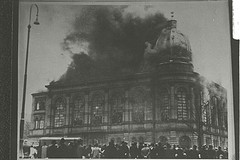
Kristallnacht  photo

Burned synagogue – night of broken glass

Kristallnacht is no longer just a dark memory in the world’s history, that night when evil emerged as a force that was not thwarted before it was too late.Destruction of synagogues and Jewish-owned stores, deaths of over a hundred and the expulsion of thousands, were encountered by the world’s silence. (Nov 9th 1938, ‘the night of broken glass’).

Today, Jews worldwide are constantly forced to deal with violent demonstrations, the burning of their synagogues, and antidemocratic laws disguised as formal judicial arguments. Up till now (Aug 3, 2014), in France alone, three synagogues were set on fire by Islamic radicals. Signs posted in Belgium taunted: Jews are prohibited to enter! Verbal violence can quickly escalate to life-threatening violence: less than a month ago, in Calgary, several participants in a Support Israel rally were attacked with severity enough to send them to hospital. Nor is Halifax immune: on July 29th, there was a pro-Hamas demonstration in Canada’s ocean’s playground. It was led by an American, who is a known associate of outlaws, an Imam named Jamal Bedawi. The demonstrators praised the Hamas and raised an ISIS flag. I am writing this column to warn you that the seeds of radicalism were planted in the indifferent streets of Halifax at that demonstration.

In 1938, that night between Nov 9th and the 10th was a checkpoint, a test. Hitler paused to see what the world’s reaction would be to the planned pogrom. Well, “the world” was not touched. The result of that?  A green light flashed to Hitler to continue with the Final Solution.

What starts with Jews never ends there; hatred’s target is not only Jews. Throughout much of the Middle East, sub-Saharan Africa, and Asia, Christians are being persecuted by radical Islamists. Baha’i in Iran, the Yazidi of Iraq, and other minorities,  are being expelled and tortured wherever radical Islam rules. It must be emphasized that, in Islamic states, the victims of the radicals are, by and large, Muslims.

Ethical people should not tolerate hate-sponsored demonstrations on their city streets.
Moral action does not consist of listening to lectures about the value of ethics while passively ignoring the spread of immorality. True morality entails active protest when, unfortunately, such protest is needed. Evil such as we see today does not voluntarily leave. It needs to be fought and defeated.

What can we, citizens and residents of Halifax, do to act morally and to combat even the possibility of terrorism here at home?

A simple look at the recent pro-Hamas demonstrations on Halifax’s main streets would show hundred and fifty Hamas supporters versus a handful of Jews. But that is not the case. We were certainly outnumbered but we were not unheard. We flew two flags, the Canadian red and the Israeli blue. We saw the relief on spectators’ faces, as they realized that there are those who, like them, oppose radicalism. At the demonstration I realized a profound thing – we are not alone! The majority of the Canadian public do not want a radical pro-Hamas neighbor.

So, again, how can each of us stand against the radical Islamic bully?

–       Speak out against Hamas, the Muslim brotherhood, ISIS, with as many people as possible. Talk to colleagues at work, chat with friends in social activities, converse with family, and let the discussion rise on the streets.

–       Strengthen moderate Muslims who are suffering from inclusion with radicalism.

–       Next time there is a pro-terror demonstration, be there! Encourage your friends of every denomination to participate in opposing the next demonstration. In this way, we will change the numbers, and stand as the majority we actually are.

–       When you see pro-Hamas protestors in public places do not ignore them. Express your contempt and objection in a way that passersby’s will see the hatred and lies will not be tolerated on our streets.

–       If you hear anti-Jewish or anti-Israeli comments, confront them outloud, in a way that will identify the speakers as the liars they are.

–       Remember that there is one powerful way to fight lies – to tell the truth.

As representations of a modern society, believers in the God of peace, compassion, love and justice, WE ARE THE MAJORITY whose voice must be heard loud and clear declaring:

There is no room for radicalism of any sort on our streets!


On the eve of a new year, may we all merit:

תָּחֵל שָׁנָה וּבִרְכוֹתֶיהָ  תִּכְלֶה שָׁנָה וְקִלְלוֹתֶיהָ..”
..there ends a year and its maledictions and a new one begins with its blessings”


Photo by Center for Jewish History, NYC

Literary analysis of Psalm 17

Distinct differences in tone, mood and theme, divide Song 17 into 3 parts: verses 1 to 8, 9 to 14, and the final verse, 15.
Each of the first 8 verses centres upon imagery of the body: v. 1, ear and lips
                                                                                                           v. 2, face and eyes
                                                                                                           v. 3, heart and mouth
                                                                                                           v. 4, lips
                                                                                                           v. 5, feet
                                                                                                           v. 6, ear
                                                                                                           v. 7, hand
                                                                                                           v. 8, eye
The singer’s argument is that his “guileless lips” (v. 10, his mouth that has not transgressed, have guarded his feet from stumbling (v. 5); his surety comes both from his having followed God’s dictates and from knowing that, accordingly, he will be found righteous by God. Indeed, as he declares in verse 8, God will

                                            Guard me like the pupil of the eye;
                                            in the shadow of Your wings hide me....

His certainty in his own rectitude and his belief that God will see in him only “what is right” (v. 2) leads him to –somewhat audaciously– direct God to hear his pleas and prayers and to show him “steadfast love” (v. 7).
The consistent image pattern of bodily organs emphasizes the likeness the singer wishes to create between himself and God; the singer’s lips are guileless because they imitate God’s by echoing the words of God’s lips (v. 4). Thus his body acts as a mirror to God, Who, beholding the singer, sees God’s image.

With verse 9, the tone and theme of the song darken. The reason the singer has asked for God’s shelter in the preceding verses is explained: his enemies surround him just as would a lion ambush its prey. The imagery of verses 9 to 14 is opposite, in intent and mood,  to that of verses 1 to 8. The singer’s enemies are described as savage beasts; powerful, arrogant and brutal:

                                          They have fattened themselves over;
                                          their mouths have spoken in arrogance.

                                          Our steps they now have hemmed in;
                                          they set their eyes roaming over the land.
                                                                                                (v. 10 – 11)

Their lips, fat with arrogance, contrast with those of the singer, whose prayers mouth the words of God; their eyes, “roaming over the land”, search for prey, in contrast to the eyes of God which seek out righteousness.
Asking God to shield him (v. 8), the singer feels himself protected by God’s care and closeness: God’s eyelids shut over him; God’s wings not only offer protection, they cast a shadow over the singer so that his presence is hidden from his assailants. So guarded and secured, the singer sends God forth as his warrior:

                                         Rise, Adonai! Go forth to meet him.
                                         Bring him down, save my soul from the
                                         wicked by Your sword….
                                                                                                (v. 13)

Verse 14 declares the singer’s victory: his enemies, by their perfidy, forfeit their share of life; whereas God’s “treasured ones” –and it is certain the singer considers himself among them– will, by their righteousness, ensure the prosperity and the future of their children.

Verse 15 is the final change in, indeed the resolution to, mood and theme. After great clamour, quietude:

                                       As for me, justified, I will behold Your face;
                                       awake, I shall be sated with the vision of You.

The purpose of the song’s imagery clarifies: in verses 1 to 8, the singer expects that his actions, his life, will be judged to be free of guile and shamefulness:

                                     From before Your face my vindication
                                     will issue forth; Your eyes will behold
                                     what is right.                                (v. 2)

Verse 15 proclaims the singer to be “justified”, his righteousness has been established. In verse 2 it is God’s face that sees the singer; in verse 15 it is the singer who will, he imagines, with eyes fully opened, perceive the Face of God. His sustenance will be not only the words of God of the opening verses, but his entire being will be animated by his vision of God. Thus physicality, the substance of the song’s imagery, transforms into spiritual exultation.


Literary analysis of Psalm 16

gold photo   Click here to read the Translation of Psalm Sixteen

Opening with three problematic verses, Psalm 16 is, nevertheless, stately, hopeful


and sure of God’s beneficence. The song centres about the image of a boundary in


verse 6: “Legacies have fallen to me, pleasant [ones].” Both Hebrew and English infer


an allotment, but the Hebrew suggests an inheritance of land whose boundaries


were measured out by rope lengths (see Notes).  The image creates for the singer his


means of delineating the difference between himself and the idolaters (v. 4);


between, that is, “the way of life” and the territory of death (Sheol, abomination, v.


10). The boundary lines of these two paths or dimensions, he insists, can never meet


or intersect. Indeed, “never” is repeated four times throughout the song (v. 2, v. 4


twice, and v. 8). But, most essentially, the image of boundary lines unites the singer


with God: his own physicality –his body — bridges the boundaries between God and


the singer in his  image of God at his right side, as if  they are in step. He completes


this image of boundaries bridged by envisioning God’s “right hand”, in verse 11,


extending “pleasures” to His followers. The singer has thereby transformed


physicality itself, that which separates humans from the divine, into an instrument


of connection, human body and divine hand meeting in metaphor.


The first line of the Psalm names a Michtam, the first of the song’s puzzles. In this


case, puzzling simply because the exact Hebrew meaning has been lost.


Interestingly, Psalm 32, doubling 16 numerically, also begins with the name, now


lost, but presumably of a musical instrument (maskil, v. 1), and, as if doubling as well


in theme, also imagines a “way”, but this time it is the singer who proclaims to the


people Israel that he “will enlighten you as to the way in which you should go” (v. 8),


as if pointing out , in the later psalm, the direction God has taught him in this, the


earlier.


The second verse of the song poses another puzzle, this one a problem of ambiguity:


the last line of the verse declares, “my good is never up to You.” It could be that the


singer is stating that God does not owe him the quality of goodness; that goodness is


his own responsibility or choice. Or he could be asserting that God alone is his good.


Both interpretations are equally valid; in each, the singer affirms God. Thus the


singer pledges himself to God, through goodness, before contrasting himself to


those who “pledged” to “others” (v. 4), through savagery: pouring “their libations of


blood” to idols.


Whether or not these idol-worshippers are “the holy ones who are in the land, and


the powerful” is the puzzle in verse 3. For the singer adds, “all my desire [is] for


them”.  While he may be describing the devout whom he wishes to emulate –not the


idol-worshippers, that is, but, in fact, their opponents—it is more likely that he is


actually berating the idol-worshippers for their pretense of holiness, despite their


public authority.  This interpretation takes its credence from the very word “idol”:


the Hebrew root of “idol”, עַצְּבוֹתָם֘ , is similar to that of “sorrow”, עֶצֶב. The implication, then, is more subtle than sarcasm. It ensures the fulfillment


of the singer’s prophecy in verse 4: “Bountiful will be the sorrows of those who


pledged [themselves] to others”.  Their allegiance to idols has, certainly in the


Hebrew text, made their future of sorrow inevitable.


Verse 5 expands the contrast between the singer and the idolaters, though not

explicitly. Again the contrast is described in the words themselves. The blood


libations of verse 4 have their counter in verse 5 in the word ‘lot”:


Adonai, my share of my portion and of my cup,

You sustain my lot.


The Hebrew word for “lot”, גּוֹרָלִֽי, has the connotation of destiny as well


as of an allotted portion. The singer is thereby affirming that God is his allotted


destiny, his allegiance to God one of all time. His “cup “of benediction is the negation


of the blood of the idolaters’ cup: theirs is the spilt life-force of those they slaughter;


his, the transforming nourishment that is his “portion”. And so he makes clear that


his “legacies” of verse 6 are spiritual ones, not merely the allotment or portion of


land implicit in the Hebrew word.


The last 5 verses of the song build a sequence of bodily imagery: the singer declares


In verse 7 that “even [in the] nights, tormented me my conscience” – the literal


meaning of the Hebrew word for “conscience” is “kidney”, the organ that metaphorizes, in Biblical writings, the location of moral sense. And verse 9 proclaims,


“my being rejoices”; the literal Hebrew meaning for “being” is “liver”, the Biblical


seat of consciousness.  His body, sustained by God (v. 5), will never stumble (v. 8),


but will “rest securely”, no longer tormented but “gladdened” and rejoicing (v. 9).


The name “Adonai” sounds throughout the song (v. 2, 5, 7, 8), its four-times


repetition transforming the four repetitions of “never”. Negation has been


nullified as the song ends on jubilation. The song itself has mapped out “the way


of life” and the singer sees his bounty, his allotment, to be both “gladness’ and


“pleasures”, both emanating from God.  Imaging God’s “face” and “right hand” in the

song’s final verse, the singer metaphorically suggests a physicality that serves to


describe the guidelines to his song’s mapping. The last word of the song, “eternally”,


transforms time’s boundaries. “Life” and “eternally”, two words of affirmation,


allow the singer to follow, to “know”, God’s endless “way”.

gold photo