Literary analysis of Psalm 28 – I will thank Him with my song.

voice photoThe dominant imagery of Song 28 is, appropriately enough in a praisesong, that of sound:

                                                      To You, Adonai, I call.
                                                                                My Rock, do not be deaf to me….(v. 1)
                                                      Hear the sound of my pleading
                                                                                when I cry out to You…. (v. 2)
                                                      …. [the wrongdoers] who speak peace to their fellows (v. 3)
                                                      Blessed is Adonai
                                                                                for He has heard the sound of my pleading (v. 6)
                                                                           .... and with my song I acclaim Him (v. 7)
The song has four sections: the first, verses 1 and 2, is the singer’s plea to God to hear his prayer. The first verse contains a paradox — God, Whom the singer calls “My Rock”, is asked, “do not be deaf to me” — the solidity and impassiveness of a rock seemingly at odds with any sort of perception; certainly with the physical one of hearing. And yet the plea honours God to Whom it is addressed, for it  recognizes that, while God has the strength of rock, God, more essentially, hears –has understanding– a capacity that a rock, of course, cannot have.
The singer’s pleading rises upward, just as his hands “lift up” toward God’s “holy Shrine” (v. 2). The upward movement is countered by the stark image of the singer’s fate should God not listen to his prayers: “Lest….I be like those gone down to the Pit” (v. 1). And the sound itself of the singer’s cries has its contrast in the silence of God should God not heed his call: “Lest You be mute to me” (v. 1). The implication, however, that the singer will be heard is inherent in the order of the verses’ imagery: while the first verse depicts the bleak fate of the singer should God refuse him, the second verse consists of the singer’s prayers; the motion of his hands, uplifted in unison with his song, counters the image of the abysmal Pit.
The second section, verses 3 to 5, describes the hypocrisy of the wrongdoers whose fate the singer prays will not be his:
                                                      Do not pull me down with the wicked,
                                                                              and with the wrongdoers,
                                                      who speak peace to their fellows
                                                                              with foulness in their heart. (v. 3)
He hopes that their wickedness will not only defeat them but will rebound upon them, so that they will suffer just as they have caused their victims to. “Pay them back” is the twice repeated entreatment of verse 4, its insistence giving a sense of urgency to the request. The “acts” of the wicked (v. 4) oppose the “acts of Adonai” (v. 5). “Their handiwork” (v. 4), the nihilistic opposite of “His handiwork” (v. 5). Their destructiveness is directed not only toward their fellows, and their denial not only that of God, but their enmity extends toward all creation:
                                                      For they understand not the acts of Adonai
                                                                                and His handiwork they would destroy and not build. (v. 5)
They are, then, the inhabitants of the Pit the singer fears in v. 1; the verb “pull down” of v. 3 echoing the “gone down to” of v.1, so that both words and ideas, structure and content, make clear the connection between the wrongdoers and the abyss.
Verses 6 and 7, the song’s third section. change both its focus and mood. The past tense of the verbs –“He has heard” (v. 6)*; “I was helped” (v. 7)– states that, in the space between the sections, the singer’s prayers were answered.  His gratitude is expressed in the present tense –“In Him my heart trusts …. and I acclaim Him” (v. 7); the juxtaposition between the two tenses, past and present, infers that his gratefulness to and trust in God will define his future as well:
                                                     Adonai is my strength and my shield.
                                                                           In Him my heart trusts.
                                                    I was helped and my heart rejoiced,
                                                                           and with my song I acclaim Him. (v. 7)
Even the sound of the singer’s praise is magnified by the word chosen by the singer to describe it:  to the Hebrew word for “praise”, “o-de-nu”, the singer adds the letter “hey” (ה), changing the word to “ah-ho-de-nu”, “acclaim”, thus creating the sense of sound reverberating, echoing and re-echoing in the very air. The “hey”, in effect, creating a resonance box.
And the singer’s song does, in effect, peal out in its last section, verses 8 and 9, as he transcends his individuality to join the people Israel. God, Who, in v. 7, is the singer’s “strength” and “shield”, his “rock” in v. 1, is now “His people‘s strength” and his protection their “stronghold of rescue” (v. 8). The idea of rescue secured rectifies the threat of the Pit in v. 1; the “stronghold” re-imagines the image in v. 2 of God’s “holy shrine” by adding to it the connotation of protection. What the singer had pleaded for himself –to be heard, to be rescued– is now granted all of God’s “estate” (v. 9): just as the singer had acknowledged “Blessed is Adonai” in v. 6, so now, at the song’s closing sound, God’s blessing enhances the nation.
The last line of the song turns the idea of “rescue” into a vision of tender care:
                                                         Rescue Your people
and bless Your estate.
Tend them, bear them up for all time.
Robert Alter, whose translation of the Hebrew into English I quote in this analysis,  explains in his footnote to v. 9: ” The first of these two verbs [‘tend them, bear them up’] is the one used for a shepherd’s looking after his flock. It is likely, then, that the second verb, ‘bear’ or ‘lift up’ (the same word used for the hands in prayer in verse 2), also refers to a pastoral context — the act of a shepherd bearing a lamb in his arms.” (Robert Alter’s translation of “The Book of Psalms”, p. 97)
David, while envisioning the protection God extends to His people — while, in fact, asking God for that sanctuary (“Rescue Your people”)– does, at the same time, distance himself from them. He asks God to tend not “us” but “them”. The verse preceding gives the explanation for his doing so: Adonai is “His anointed‘s stronghold of rescue”. David, anointed by Samuel, is Israel’s ruler (1Samuel 16:13) By seemingly distancing himself, then, he is neither arrogant nor disdainful. Rather, he is identifying himself as king, and his people, in his care. He begins his song imaging himself as helpless, fearful both of God’s turning from him and of his enemies; he ends with the identification of himself as God’s anointed. The last line of his song is, accordingly, the king’s prayer for his people. His care of his people is the obligation of kingship’s term; God’s, he recognizes and affirms, is “for all time’.
* V. 6, “for He has heard the sound of my pleading”, echoes v. 2, “Hear the sound of my pleading” but for the verb tense.

voice photo

Literary analysis of Psalm 26 – But I walk with sincerity; redeem me and be gracious to me.

baby photoAlthough it is certainly a praisesong, Song 26 seems intended to be spoken, rather than sung. Probably because it is a self-defense, as if it were being argued in a divine court (“the abode of Your house”, v.8), before the judge, Adonai. No prosecutor; simply the closing arguments of the defendant. That argument is framed by two verbs that sound, clarion, a plea — “Judge” in v. 1; “Redeem”, v. 11.

The defendant argues that his righteousness merits God’s testing him. The verb “try” suggests that it is God who has put him on trial:
Test me, Adonai, and try me.
Burn pure my conscience* and my heart.  ()v. 2)
Both his body and his soul exemplify, he believes, his worthiness. Thus he lists the purity of his kidneys and heart (v. 2), the cleanliness of his palms (v. 6), and the steadiness of his feet (v. 12) as testifying to his integrity, a quality itself manifested by his avoidance of liars (v. 4), despising of evildoers (v. 5), and shunning of bloodthirsty men (v. 9). Through God’s testing of him –indeed, His judging of him– he will prove, he argues, his righteousness. His evidence he presents, repeatedly throughout his testimony, through the metaphor of walking:
 For I have walked in my wholeness (v. 2) ….
 I shall not stumble (v. 2)….
and I shall walk in Your truth (v. 3)….
But I shall walk in my wholeness (v. 11)….**

As his own advocate, he separates himself from evildoers (verses 4, 5, 9, 10); their hands, holding onto plots and open to bribes (v. 10), the antithesis to his own washed palms. Two polar opposite verbs emphasize –in effect, shout out– the difference he asserts between himself and them: hate and love. Verse 5 declares, “I despised the assembly of evildoers”; verse 8, “Adonai, I love the abode of Your house”. Although his purpose is to make sure that God distinguishes between him and the evildoers, the verses describing those evildoers pertain solely to his relationship with them. In contrast, all the other verses of the song concern his relationship with God alone. Thus one line of each of these verses describes the defendant’s gratitude to God, and the other line, the Godly qualities for which he is grateful. Verse 3, as an example:
.
The effect of this contiguity is that God is not only the defendant’s judge, but, indeed, his one witness. His argument, begun with the plea, “Judge me”, ends with “Redeem me”. A puzzle. If he is so sure of his wholeness, of the worthiness of both his body and his soul, why does he ask for redemption? Actually, the very request, “Judge me”, reveals his humility. His is not an arrogant statement of self-praise. He stands, in his perceived court, with confidence; indeed, his metaphor of walking alters, in the closing verse, to that of standing –“My foot stands on level ground” (v. 12)– as if to show how sure he is of his own rectitude. His realization seems to be that redemption rests upon –that is, it is the result of–  judgement. Only after God has passed judgement upon the defendant, can he be redeemed.

At his argument’s close, having put forth his case, the defendant asks of God one boon: “grant me grace” (v. 11). Even though he is righteous, David realizes that redemption is a matter of God’s grace rather than David’s right. In turn, he will join with the chorus of the righteous who sing blessings to Adonai. The argued defense transforms into song.

*The English “conscience” is actually “kidneys” (the seat of the conscience, in Biblical belief) in Hebrew.
**The past tense of “have walked” in verse 2 alters to the future “shall walk” in verse 11, indicating the defendant’s certainty that his future will mirror his past acts and intentions.

baby photo

Literary analysis of Psalm 25 – “To You, O Lord, I will lift up my soul”

missing photoSong 25 makes an intruder out of its reader or listener. The sense is of overhearing an intensely intimate prayer.* And yet, paradoxically, the frame of the song, that which determines its structure, is formal — each line begins, in Hebrew, with a letter of the alphabet, in their proper order. Perhaps the contradiction between such an ordered structure and so personal a prayer can be explained by the very fact that the singer is using the format of the alphabet: the Kabbalists believed that the Hebrew letters “are the structural elements, the stones from which the edifice of Creation was built” (Gershom Scholem, On the Kabbalah and Its Symbolism, p. 168). Though there are over 2000 years between King David and the Kabbalists, certainly as a poet –and, afterall, David’s Praisesongs are songs in words– he would know that the letters of the alphabet are the writer’s only means of embodying thought. The singer’s central theme in Song 25 is of his own unworthiness and of his hope for redemption. If, then, the letters are essential to compositions in words, what more appropriate way to express his theme than by using the alphabet format? That is, the very letters that underlie creation –be it of the universe or of individual writings– reveal David’s attempt, to re-create, re-form, himself, so that he will be worthy of redemption.
The song is composed of four sections. The first, verses 1 to 7, pleads with God to be beneficent toward the singer, to be led by His “compassion” and “steadfast love” when considering the singer’s youthful “sins and transgressions” and to teach the singer God’s “paths” of truth that he might triumph over his “baselessly treacherous” foes. The pattern of repetition in these verses gives a sense of the melody within one line of verse being picked up in the next line of the same verse and then again sounded in the verse that follows. Thus “shamed” in v. 2 reappears twice in v. 3; “hope” in v. 3 echoes in v. 5; “paths”, voiced twice in v. 4, reiterates in v. 5; the parallel “instruct” and “inform” in v. 4 reappears in “instruct” in v. 5; “kindness” in v. 6 repeats in v. 7, along with its synonyms, “mercies” in v. 6 and “goodness” in v. 7; “recall” in v. 6 is the twice repeated verb in v. 7. The effect is of a tapestry of words, as themes weave together. Even the ideas the words express intermingle, as the singer turns from personal prayer (verses 1, 2, 4, 5) to a plea for all who trust in God (v. 3), then to a consideration of those very attributes of God (v. 6) which will allow God’s compassion to His followers, but disgrace to his deniers.
 –
 The song’s second section, verses 8 to 14, further describes God’s qualities –goodness, uprightness; just, kind and truthful in judgement. God’s “paths” of the first section becomes His “way” in the second; in both, God is portrayed as guiding His followers. The life of his follower will, accordingly, “repose in bounty, and his seed will inherit the earth” (v. 13). To him will God make known His covenant (v. 14). Verse 11 seemingly breaks the pattern by re-introducing the singer’s individual plight. But, in fact, the verse splits in two: its first line praising God’s name; its second, asking for forgiveness for his sinfulness, just as he had in v. 7. Thus the verse connects the two sections of the song, being both praise and a plea:
                                                          For the sake of Your name, Adonai,
                                                                                   may You forgive my crime, which is great. (v. 11)
 –
Verses 15 to 21, the song’s third section, resound the singer’s plea for forgiveness:
                                                          My eyes at all times to Adonai,
                                                                                 for He draws my feet from the net.
                                                          Turn to me and grant me grace,
                                                                                  for alone and afflicted am I.
                                                          The distress of my heart has grown great.
                                                                                   From my straits bring me out. (v. 15, v. 16, v. 17)
The theme of the singer’s loneliness and distress in these three verses begins with “my eyes” (v. 15) –the singer’s eyes are, at all times, fixed upon God. The implication is that he both seeks out God’s ways and follows them. In turn, he asks God to be mindful of his distress and of his enemies’ perfidy. Verses 18 and 19, complementing v. 15, each begin with the verb “see” (“See my affliction” in v. 18 is followed by “See my enemies'” in v. 19). While verses 18 to 21 resound the themes of the song’s first section:  “affliction and suffering” in v. 18 pick up the offenses and crimes of v. 7 and v. 11; the enemies in v. 19 are those depicted in v. 2 and 3; the shame that v. 20 seeks shelter from is that of v. 2 and v. 3; and the hope of v. 21 echoes that of v. 3 and v. 5. The section ends as it begins, with affirmation and assurance –God who “draws [his] feet from the net” of his enemies in v. 15 will “guard” and “save” the singer in v. 20 so that he will find “shelter in You'”. And finally, as the song closes with its fourth, one-line, section — “Redeem, God, Israel from all its straits”– the plea the singer utters for his own self, in v. 17 (“From my straits bring me out”), transforms into his prayer for all the people Israel.
 –
The alphabet framework of the song is straightforward, with the interesting variation of v. 2, which gives precedence to Adonai over the letter “bet”, so that “aleph” begins the first word and “bet” the second word of the opening of the one verse, rather than the expected pattern of the second letter beginning the next verse, v. 3. (Verse 3 begins with “gimmel”.) The remainder of the letters of the alphabet proceed to form, in turn, the first letter of the first word of each verse progressively til the song’s end. But for one striking puzzle:  the 6th letter, “waw”, and the 19th, “qof”, are both omitted from the frame. The reason for the omission may be in the Hebrew word for “hope” whose root is comprised of these two letters, along with “het”. For, of the several words for “hope” in Hebrew, it is this particular one the singer chooses in his 3 repetitions of the word in the song (v. 3, v. 5, v. 21). Moreover, the addition of the “het” to the “gof’ and “waw” increases the positive connotations of the word “hope”. For its very shape is commonly compared to a doorway; in this case, one through which the righteous may enter that state of being predicted by the singer in verses 12 and 13:
                                                          Whosoever the man who fears Adonai,
                                                                                     He will guide him in the way he should choose.
                                                              His life will repose in bounty,
                                                                                      and his seed will inherit the earth.
                                                            .
Thus, rather than an omission, the two letters are, on the contrary, sounded –indeed, trumpeted– within the song.**
*Perhaps this is the reason that Sephardic Jews recite Song 25 upon beginning the Amidah prayers.
**Jeremiah uses the noun “hope”, formed of the exact same root, to declare that Adonai is the hope of Israel (14:8; 17:13; 50:7).
missing photo

Literary analysis of Psalm 24 – Who shall go up on the mount of ADONAI

The sound and the sense of Song 24 suggest a pageant. In contrast to the personal tone of Song 23, Song 24’s is formal, dominated by rhetorical questions and answers, as though two voices, or, more probably, two choruses are meant to sing the roles of questioner and responder.

בית המקדש photo

The song begins with a declaration of allegiance: all of earth belongs to its creator —
                                        The Lord’s is the earth and its fullness (v. 1)
The very word “fullness” connotes creativity, abundance.
The verse following explains the reason for the fullness; its source is God who “on the seas did found it, and on the torrents set it firm” (v. 2)  — a re-iteration of the description in Genesis of God’s creation of the earth, of the initial separating of the firmament and the waters. The song’s concern is not with the act of separation or with the waters, but with the firmness of the earth; though its foundation is the torrents, it is, nonetheless, solid and its characteristic of stability the opposite of the churning motion of the waters.
Having established the undissolvable connection between God and the earth, the song adds a second theme — one melody leading to another. Verses 3 to 6 describe the qualities that the individual must possess in seeking God’s presence:
                                         The clean of hands and the pure of heart,
                                                                 who has given no oath in a lie
                                                                                 and has sworn not in deceit. (v. 4)
Those qualities are three: hands and heart, both must be pure; the “and” making clear that action and intent are joined, one the equivalent of the other. The stipulation to give no oath “in a lie”, nor “in deceit”, gives the third essential element –mouth; speech, acts, thoughts, all must correspond.
The image of the mountain in verse 3 introduces the theme that will dominate the rest of the song, that of humankind ascending, and God descending; their meeting-point possible only through those pure enough to be counted among the generation of seekers who venerate Jacob, he who is, afterall, the father of the twelve tribes of Israel:
                                      Who shall go up on the mount of the Lord,
                                                              and who shall stand up in His holy place? (v. 3)
Those pure ones will receive God’s blessing and reward:
                                       This is the generation of His seekers,
                                                                those who seek out His presence, O Jacob. (v. 6)
The final four verses of the song add a third theme, a melody in which the chorus divides into questioner and responder. The symbols of gates and portals join that of the mountain; indeed, earth, in its fullness, shows its readiness to rise up to greet Adonai: the Creator, the Ruler, the Warrior  — all aspects of sovereignty —   is hailed, proclaimed, beseeched to enter:
                                       Lift up your heads, O gates,
                                                             and rise up, eternal portals,
                                                                            that the king of glory may enter. (v. 7)
“Lift”, “rise” are the verbs of the earth’s greeting; “may enter”, the bounty that the king of glory bestows  — the “may” expressive of the singer’s humble hopefulness.
Song 24 is recited during Monday, Thursday and Sunday services, when the Torah is returned to the Ark. The praisesong chosen for its appropriateness, for the Ark, the repository of God’s teachings, is the material embodiment of the gates, portals and mountain, the symbols of the people Israel’s responsiveness to God. Accordingly, it is also the praisesong sung in the High Holidays along with the prayer for sustenance.
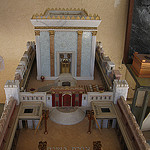
A midrash from Talmud Shabbat   (p. 30) emphasizes how essential a place this praisesong must have, not only in Jewish prayer, but, indeed, in its religious pageantry: when King Solomon prepared to open the gates of the Temple –the first Temple, his construction — to allow the Ark to enter for the first time, the gates refused to lift. Only when he recited his father’s song, song 24, verses 7 to 10, did the gates rise up, permitting the bearers of the Ark to bring it into the Temple.
בית המקדש photo

Literary analysis of Psalm 23

Shepard sheep photo  Click here to read “Psalm Twenty-three: Translation of the Song”

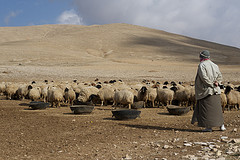
The metaphor that opens Song 23, of the shepherd and His sheep, evokes a sense of safety: a shepherd does not merely herd his sheep, as his name implies; his duty is to ensure their safety –to keep them from straying and to protect them from predators. The singer, however, does not identify himself as a sheep; that is, of course, implicit within the metaphor, but, more important, the absence of such mention indicates that he takes his identity solely from God, his shepherd. Nor is a flock mentioned in the song, though the nature of a sheep is that it is part of a flock. Certainly, then, the singer’s concern is only with his relationship with God, not with his community. His physical wants are satisfied  –“I shall not want” (v.1); he is provided both food and rest:. (v.2)
The choice of verbs, moreover  –“makes”, “guides”– makes clear that the singer is led; he does not choose his own direction but trusts that provisions will be granted him.
The next verse acknowledges that, indeed, he owes his very life to God, his shepherd. The usual English translation is, “He restores my soul.”  The Hebrew, however, is “nefesh”, meaning “breath”, rather than the higher entity the English suggests. Nonetheless, what the singer is recognizing is that his life is continually restored, ensured, by his protector.

The second line in verse 3, however, alters the metaphor. God still leads the singer but the paths are ones that only humankind can tread:
He leads me on pathways of justice
                                                                        for His name’s sake. (v.3)
Justice or righteousness are human concepts; the singer is revealing his own humanity but he is also continuing to acknowledge that those concepts have been inspired by God. The puzzling “for His name’s sake” clarifies: God leads precisely because God is the guide to those precepts of righteousness and justice; those precepts name God.

In verse 4 the pronouns change, from the formal “he” and “I” of the preceding verses, to the more intimate “I” and “You”. Again, an acknowledgement of the singer’s humanity. Though God continues to lead him, the singer addresses “You” –an acknowledgement, that is, of relationship. The metaphor holds –the rod and staff are shepherds’ implements. But now the singer is no longer led. The tense of the verbs change from passive to simple present. He “walks”, he does not “fear”; he is “comforted”; God is “with” him  –a companion rather than the one who directs. Companion, however, does not mean equal; it is God who holds the rod and the staff, not the singer.

The first line of v.4 has, just as does v.3, a different intent in Hebrew than in English. The usual English translation is “though I walk through the valley of the shadow of death”, posing a complicated paradox:  either the valley, most likely life, is shadowed by death’s inevitability or the valley is part of, belongs to, death’s shadow –a much more ominous possibility. And, if death casts a shadow, is it, then. an entity capable of obscuring the light that would otherwise fall in fullness upon the valley? Another ominous possibility.
The English is unclear simply because the Hebrew is obscure: “tsalmawet” does not exist as a one-word form in the language. It may derive from “tsel”, meaning “shadow”, and “mawet”, meaning “death”. According to the translator Robert Alter, the philological assumption is that “tsalmawet” may arise from a mispronunciation of “tsalmut”, a poetic word for “darkness”. At any rate, both the Hebrew and the English describe a valley shadowed by darkness or death. And even if the one-word “shadowdeath” implies that death is itself a shadow, is, that is, without substance, still the valley is ominously affected by it. The bleakness of the image, whatever the reading of the Hebrew or English phrase, is assuaged, regardless, by the comfort of “You are with me” –the singer’s recognition of God’s presence:
Though I walk in the vale of death’s shadow,
                                                                        I fear no harm,
                                                                                     for You are with me. (v.4)

Verse 5, harkening back to v.2, lists the physical comforts God’s presence provides the singer –“You set out a table before me”, “You moisten my head with oil, my cup overflows”: all the provisions –the oil, wine, and overflowing table– offering a bounty of prosperity and well-being to the human guest that is as vital an abundance as are the green pastures to the sheep.

Verse 6 returns to the implications of v.3: the human qualities of goodness and kindness that transcend, by their inherent morality, the physical needs of all creatures:
Let but goodness and kindness pursue me
                                                                     all the days of my life.
                                               And I shall dwell in the house of the Adonai
                                                                      for many long days.      (v.6)
The singer, no longer led, but his own leader. It is goodness and kindness that pursue, that follow him; they, in effect, his sheep, but only because he chooses, as his own, God’s direction. Emitting goodness and kindness, he is able to live in God’s house –the shelter and provider, afterall, of moral values.

Shepard sheep photo

Photo by Bombardier

Photo by Bombardier

Literary Analysis of Psalm 22

Two visions create Song 22; one perceives the present and one, the future. Each describes an extreme state of being and each is the polar opposite of the other.

The song opens with the voicing of an anguish so intense that, more than a cry, it is, in the singer’s words, “roars”, the image suggestive of a lion (v. 2). Yet no aggression, but rather despair, issues such sounds; the singer’s terror at being abandoned by God: “My God, my God, why have You abandoned me?” His roar of words receives no answer, its noise diminished by an invasive silence:

My God, I cry out all the day, but You do not answer, and all the night, but no quietude for me. (v. 3)

The image is bleaker in Hebrew than in English, for while “quietude” suggests “respite” in English, the Hebrew root of דּוּמִיָּה connotes paralysis, a freezing of the blood. However, in both languages, the singer’s despair is made more acute as he remembers God’s aid to his forefathers (verses 5 and 6) and, indeed, his own safe haven in God in his infancy (verses 10, 11).

His distress he pictures in a series of metaphors that span, first, the hierarchy of creatures –from lion (v.2) to worm (v.7)– descending into the terrifying description of his own dissolving flesh and bones: he images his foes encircling him as a pack of scavengers (verses 17-19),  waiting to devour their carrion (their only sign of being human, and not actual curs, their division of spoils even before they attack); his terror at their impending assault, with no protection accorded him by God, turns his flesh into water, until, his bones and organs having dissolved, he is emptied of vitality, left as the mere dust of death (verses 15, 16):

Like water, I was spilled out, and all my bones came apart;
my heart was like wax, melted in my bowels. (v. 15)

              Dried up like clay is my strength, and my tongue cleaves to my palate,
and You will set me in the dust of death.
(v. 16)

The singer has stripped himself not only of his human form but, indeed, his humanity; without God’s favour, he becomes, in his own eyes, less than human. Just as his foes, anticipating their triumph over him, act savagely; their inhumanity turning them into marauding beasts, “a ravenous, roaring lion” (v. 14). Thus the singer’s vision of his own vulnerability begins with his words, roaring, and ends with men whose baseness destroys their humanness. Even their taunting of him denigrates and profanes the singer’s trust in God: “Roll your way to Adonai” (v.9) – their goading imagining him somersaulting, like a child, or, worse, and inanimate object whose movement can only be impelled by another. Accordingly, God’s favour becomes, for them, not a benediction but a jeer: “He will rescue him, He will save him, for He desires good for him” (v.9).

At the very moment when the singer’s voice would seemingly be still, and his enemies’ roars the only sound to be heard, he calls out to God to aid him (verses 20,21). Into the vision of a world devoid of any human beings, the human emerges. In the space between the first line of verse 22 –“Deliver me from the mouth of the lion”–and the second –“from the horns of the bull You did answer me” –something unknowable occurs. The bleak vision of the song’s first half gives way to exultation.

In asking to be rescued, the singer is certainly referring to his enemies as ‘”the mouth of the lion” (v.22), but the image echoes his description of his own cries in the song’s opening verse –“the roars that I utter” (v.2). The singer is asking, that is, to be freed from his own roars, from his own desperate point of view. And, indeed, that is exactly what occurs. The analogy to Isaac, saved from sacrifice by the appearance of the ram (bull) sent by God (v.22), makes clear the singer’s sense of his own miraculous escape from death, from his deathly vision. And yet the change in the tense of the two verbs, from present to past, within the same verse, adds a puzzle –the singer has been rescued even before his plea:

Deliver me from the mouth of the lion; from the horns of the bull You did answer me. (v. 22)

It would seem that the singer, then, is, from one moment –one line– to the next, recognizing that God has answered his plea in the past, and that he finds, in that instant of recognition, the very answer he has, throughout that space of time comprising verses 1 to mid-22, been waiting for.

His humanity reclaimed, the singer is now able to do just as his fathers had done –to, as verse 4 declares, enthrone God “in [by means of] the praises of Israel”.  His vision in verses 23 to 32 is of a world redeemed. Not only does he acknowledge God’s compassion to all you who are “the seed of Jacob” (v. 24), and God’s awareness of “the pleading prayer of the needy” (v. 25), but he envisions a time when

One end of the earth to the other will remember and return to ADONAI
and all the family of nations will bow down before You.
(v. 28)

Moreover, God’s rule will extend not just to the nations of the world, but to “all those who will go down to the dust” (v. 30); indeed, even to those yet to be born, “to the generations to follow” (v. 31). Thus all humankind –past, present, future– will unite to praise and acknowledge God; a people, reborn, without want –“The humble will eat and be satisfied” (v. 27)– proclaiming God’s bounty, their praise songs surely David’s own.

The second, the exultant, vision within the song answers the first, the despairing one and transforms its images: thus verse 20’s beseechment to God, “be not distant”, resounds verse 12’s “Do not distance Yourself from me”; yet rather than simply echo the earlier verse, the later one leads, not to the fearful cry, “for torment is nearby”, of verse 12, but to the declarative “You did answer me” of verse 22. The surety of that declaration denies, as well, verse 3’s assertion, “but You do not answer”. Similarly, verse 25’s avowal, “For He did not despise and did not detest” the prayers of the needy refutes verse 7’s depiction of the singer as reviled and disgraced. Even the creature of dust, with palate “dried up like clay”, of verse 16, is given its revitalized and opposite form in those multitudes of verse 30 who have gone “down to the dust” but who kneel, with the living, before God.

Two words and their variants –“praise”, as both verb and noun, and three variations of verbs of speech (“speak”, “tell” and “declare”) – repeat throughout the second part of the song, promoting its vision’s exultation: “praise” occurs in verses 23, 24, 26 and 27, ensuring the enthronement of God suggested in verse 4. “Speak”, verse 23, “tell”, verse 31, and “declare”, verse 32, make stronger, in their various forms, the sense of mere telling or repeating. Praises, spoken, become chorus.

Even the one repetition in the first section –‘trust”– is a subversive comment on the singer’s despair;*  the fathers’ trust, emphasized twice in verse 5, again in verse 6, becomes the overwhelming, central quality of the nations in the song’s conclusion. The trust of the singer as an infant taken out of the safety of his mother’s womb (verse 10) has its fulfillment in the concluding “a people being born” (v. 32). The assertion that generation after generation will hear of God’s righteousness takes the song back to its opening line, both completing and explaining it. “Ayelet haShahar” may refer to a musical instrument – this is, in fact, the usual assumption – but the Hebrew words translate literally, “deer of the sunrise” or “radiant deer”. The radiance, then, is God’s righteousness; the time of day, sunrise, an apt metaphor for generations to be born into the words of their people’s praises.

*The Hebrew word for “declare”, אֲסַפְּרָה , transforms the spectre of the singer’s despair by its connotation of creativity: the root of the Hebrew for “declare” is the same as the root of the verb “count”, ס.פ.ר.

foresaken photo

Photo by TheMarque

Literary Analysis of Psalm 21

Both the structure of the praisesong and its themes are complements. Each describes the singer’s feeling of certainty; his sureness of God’s protection and his gratitude for it. No wonder, then, that the most striking repetition in the song is the word “Indeed”, that begins verses 4, 7, 8, 12 and 13, for it denotes certainty.
strength photo
The king, David, is both the singer and the subject of the song. He is sure enough of God’s bounty that he describes how God has appointed him king, how God has “set upon his head a crown of fine gold” (v. 4). His kingship becomes, accordingly, the mark of God’s favour. And yet, God’s beneficence to him causes him not to boast but to rejoice: the glory and majesty that God has bestowed upon him reflects, the singer emphasizes, God’s own strength and splendour. So proclaim verses 1 through 7.

Verse 7 is somewhat problematic:
                                                             Indeed You set for him blessings forever,
                                                             gladden him with the joy of Your face.
The “forever” echoes the “everlasting” of verse 5:
                                                             Life he asked of You;
                                                             You have granted him length of days, everlasting.
The singer may be referring to his faith having rewarded him a portion of eternity, but the song’s sphere is this world, not the possibility of the next; and if his descendants are to secure his immortality in human memory, they too have no mention in his song. “The joy of Your face” is even more puzzling. Does the singer mean that God, in blessing the king, looks upon him with joy? Or is the joy the singer’s own, as he declares his gladness for having been blessed? Or is he acknowledging that all the blessings that he, the king, has received, are due to the joyful face God has turned towards him? Probably all are valid. But the Hebrew adds a dimension the English translation lacks: it omits the preposition “of”, so that the line reads, “gladdens him with the joy, Your face”. The blessings transform, in this description, into the revealing –so much more than merely reflecting– of God’s face.

The most powerful stanza of the poem, the very centre of it both in placement (verse 8 out of 14) and statement, declares,
                                                              Indeed the king trusts in Adonai,
                                                              and through the faithfulness of the Most High, he is not shaken.

Having expressed his gratitude for God’s beneficence in verses 1 to 7, the singer describes, in verses 9 to 13, God’s defeat of the king’s enemies. If the king has been granted days everlasting, blessings forever, his enemies, in contrast, have not only been defeated, but have, in effect, been obliterated:
                                                             You destroy their offspring from the earth,
                                                              their progeny from among men.
                                                                                                                        (v. 11)
But it is in the juxtaposition of the word “face” that the awfulness of the enemies’ fate is exposed: verse 7 describes the “joy, God’s face”; verse 10 imagines the “fiery furnace when Your face appears” as, in anger, God destroys those who hate the king, “and fire consumes them”. Moreover, the very faces of the enemies are, in verse 13, the object of God’s attack: “You aim at their faces with Your bows”.
The peacefulness of the song’s first half has given way to violence, in the second half. But it is an assault their own hatred of God has brought upon the enemies.

Verse 14 is the resolution, the calm restored:
                                                              Be exalted, Adonai, through Your strength;
                                                              we sing and chant the praises of Your mighty acts.
The opening of the verse, “Be exalted”, recalls the beseeching “Arise” in Psalms 9 and 10. The Hebrew for “arise” is “kumah”; for “exalt”, “rumah”. The near exactness of the two words indicates their connectedness. The singer, as though recognizing the connection, gives the name “Most High” to God (v. 8). God has, David believes, raised him to kingship (v. 4); he, in turn, acknowledges and exalts God’s kingship. Now, however, the king’s voice is joined by those of his people. The pronoun “we” is used for the first and only time in the song. What they together praise are God’s “mighty acts”: the adjective “might” echoes the phrase “through Your strength”, the phrase that ends the song as it begins it. Might, the song realizes, is God’s; it is God’s strength that David identifies as the defeater of his enemies. But it is “we”, the people Israel, who, in sounding allegiance to God, exalt the “Most High”.

strength photo

SHABBAT CANDLE LIGHTING SERVICE

Shabbat candle lighting

CANDLE LIGHTING
בָּרוּך אַתָּה יְיָּ אֱלֹהֵינוּ מֶלֶך הָּעוֹלָּם, אֲשֶר קִדְשָּנוּ בְמִצְוֹתָּיו וְצִוָּּנוּ לְהַדְלִיק נר שֶל שַבָּת

Baruch Atah Adonai, Eloheinu Melech Ha-olam, Asher Kid’shanu B’mitzvotav V’tzivanu, L’hadlik Ner Shel Shabbat.
Blessed are You, Lord our G-d, King of the universe, Who has made us holy through His commandments, and has commanded us to light the Sabbath light.
– It is an appropriate to bless the children with wisdom and pray for shalom bayit- domestic peace at this moment of lighting the Shabbat candles. The following is one of the prayers that were written for that:
– May it be Your will HASHEM, my G-d and G-d of my forefathers, that You show favour to me (my husband | my sons | my daughters | my father | my mother) and all of my relatives; and that You grant us and all Israel a good long life; that You remember us with beneficent memory and blessing; that You consider us with a consideration of salvation and compassion; that You bless us with great blessings; that You make our households complete; that You cause Your Presence to dwell among us. Privilege me to raise children and grandchildren who are wise and understanding, who will love Hashem and fear G-d, people of truth, holy offspring attached to G-d, who will illuminate the world with Torah and good deeds and with every labour in the service of the Creator. Please, hear my supplication at this time, in the merit of Sarah, Rebecca, Rachel and Leah, our Mothers, and cause our light to illuminate that it be not extinguished forever, and let Your countenance shine so that we are saved. Amen.

HAVDALAH – Concluding service of the Shabbat

HAVDALLAH – short havdalah service

HAVDALLAH – THE SHORT VERSION

בָּרוּךְ אַתָּה ה’ אֱלהֵינוּ מֶלֶךְ הָעולָם. בּורֵא פְּרִי הַגָּפֶן:
בָּרוּךְ אַתָּה ה’ אֱלהֵינוּ מֶלֶךְ הָעולָם. בּורֵא מִינֵי בְשָׂמִים: (Smell the spices)

בָּרוּךְ אַתָּה ה’ אֱלהֵינוּ מֶלֶךְ הָעולָם. בּורֵא מְאורֵי הָאֵשׁ: (Reflection of the fire on nails)

בָּרוּךְ אַתָּה ה’ אֱלהֵינוּ מֶלֶךְ הָעולָם. הַמַּבְדִּיל בֵּין קדֶשׁ לְחל. בֵּין אור לְחשֶׁךְ. בֵּין יִשְׂרָאֵל לָעַמִּים. בֵּין יום הַשְּׁבִיעִי לְשֵׁשֶׁת יְמֵי הַמַּעֲשֶׂה:
בָּרוּךְ אַתָּה ה’. הַמַבְדִּיל בֵּין קדֶשׁ לְחל


Baruch Atah Adonai, Eloheinu Melech Ha-olam, Borei Pri Hagafen.

Baruch Atah Adonai Eloheinu Melech Ha-olam, Borei Minei V’samim.

Baruch Atah Adonai, Eloheinu Melech Ha-olam, Borei M’orei Ha-eish.

Baruch Atah Adonai, Eloheinu Melech Ha-olam, Hamavdil Bein Kodesh L’chol, Bein Ohr L’choshech, Bein Yisra-el La-amim, Bein Yom Hash’vi-i L’sheishet Y’mei Hama-aseh. Baruch Atah Adonai, Hamavdil Bein Kodesh L’chol.


HAVDALLAH – THE FULL VERSION


הִנֵּה אֵל יְשׁוּעָתִי אֶבְטַח וְלא אֶפְחָד:
כִּי עָזִּי וְזִמְרָת יָהּ ה’. וַיְהִי לִי לִישׁוּעָה:
וּשְׁאַבְתֶּם מַיִם בְּשָׂשׂון. מִמַּעַיְנֵי הַיְשׁוּעָה:
לַה’ הַיְשׁוּעָה. עַל עַמְּךָ בִרְכָתֶךָ סֶּלָה:
ה’ צְבָאות עִמָּנוּ. מִשְׂגָּב לָנוּ אֱלהֵי יַעֲקב סֶלָה:
ה’ צְבָאות. אַשְׁרֵי אָדָם בּטֵחַ בָּךְ:
ה’ הושִׁיעָה. הַמֶּלֶךְ יַעֲנֵנוּ בְּיום קָרְאֵנוּ:
לַיְּהוּדִים הָיְתָה אורָה וְשִׂמְחָה וְשָׂשׂון וִיקָר. כֵּן תִּהְיֶה לָנוּ:
כּוס יְשׁוּעות אֶשָּׂא. וּבְשֵׁם ה’ אֶקְרָא:
סַבְרִי מָרָנָן:
בָּרוּךְ אַתָּה ה’ אֱלהֵינוּ מֶלֶךְ הָעולָם. בּורֵא פְּרִי הַגָּפֶן:
בָּרוּךְ אַתָּה ה’ אֱלהֵינוּ מֶלֶךְ הָעולָם. בּורֵא מִינֵי בְשָׂמִים:
בָּרוּךְ אַתָּה ה’ אֱלהֵינוּ מֶלֶךְ הָעולָם. בּורֵא מְאורֵי הָאֵשׁ:
בָּרוּךְ אַתָּה ה’ אֱלהֵינוּ מֶלֶךְ הָעולָם. הַמַּבְדִּיל בֵּין קדֶשׁ לְחל. בֵּין אור לְחשֶׁךְ. בֵּין יִשְׂרָאֵל לָעַמִּים. בֵּין יום הַשְּׁבִיעִי לְשֵׁשֶׁת יְמֵי הַמַּעֲשֶׂה:
בָּרוּךְ אַתָּה ה’. הַמַבְדִּיל בֵּין קדֶשׁ לְחל


Hinei El Y’shu-ati Evtach V’lo Efchad, 
Ki Azi V’zimrat Yah Adonai, Va-y’hi Li Lishu-ah. Ushavtem 
Mayim B’sason 
Mima-ah-y’nei Hay’shu-a. 
LaDonai Hay’shu-a Al Am’cha Virchatecha, Selah. 
Adonai Tz’va-ot Imanu, Misgav Lanu Elohei Ya-akov, Selah.
Adonai Tz’va-ot Ashrei Adam Botei-ach Bach. Adonai Hoshi-ah
Hamelech Ya-aneinu V’yom Kar-einu.
La-y’hudim Ha-y’tah Orah 
V’simcha V’sason Vikar, 
Kein Tih-yeh Lanu. 
Kos Y’shu-ot Esah, Uv’sheim Adonai Ekrah.
Savri Maranan V’rabanan V’rabotai 
Baruch Atah Adonai, Eloheinu Melech Ha-olam, Borei Pri Hagafen.

Baruch Atah Adonai Eloheinu Melech Ha-olam, Borei Minei V’samim.

Baruch Atah Adonai, Eloheinu Melech Ha-olam, Borei M’orei Ha-eish.

Baruch Atah Adonai, Eloheinu Melech Ha-olam, Hamavdil Bein Kodesh L’chol, Bein Ohr L’choshech, Bein Yisra-el La-amim, Bein Yom Hash’vi-i L’sheishet Y’mei Hama-aseh. Baruch Atah Adonai, Hamavdil Bein Kodesh L’chol.

Shabbat – Blessings over the washing (Netila) and Challah

Netilat Yadaim N Bread-Hamotzi (short-long-reanslation)

Netilat Yadaim / Washing the hands

We wash our hands at least once with an amount of 86cc on either hand.
The main Minhag is to do so three times on each hand, starting with the washing of the right hand.

Blessing after washing:

בָּרוּךְ אַתָּה ה’ אֱלהֵינוּ מֶלֶךְ הָעולָם אֲשֶׁר קִדְּשָׁנוּ בְּמִצְותָיו וְצִוָּנוּ עַל נְטִילַת ידיים

Baruch Atah Adonai,Eloheinu Melech Ha-olam,Asher Ki-d’shanuB’mitzvotav V’tzivanu,Al N’tilat Yadayim.

Translation: Blessed are You, Lord our G-d, King of the universe, 
Who has made us holy through His commandments, 
and has commanded us about washing hands.


Hamotzi / Blessing over the Challa

Blessing over the Challa / whole bread:

בָּרוּךְ אַתָּה ה’, אֱלהֵינוּ מֶלֶךְ הָעולָם, הַמּוצִיא לֶחֶם מִן הָאָרֶץ

Baruch Atah Adonai, Eloheinu Melech Ha-olam, Hamotzi Lechem Min Ha-aretz.

Translation: Blessed are You, Lord our G-d, King of the universe, Who brings forth bread from the earth.