The opening line of the song juxtaposes the master or conductor of the musicians and the servant of God. This implied contrast contains no rebuke, no moral judgement. It simply denotes that even the most eminent among those who sing God’s praises are but servants of their divine ruler. However, the contrast that follows, that makes up the remainder of the song, is indeed a reprimand: the wicked man, choosing to be controlled by malevolency, is not only contrasted with but is defeated by God Whose governance extends throughout the earth.
Verses 2 to 5 describe the wicked man who listens to the voice of a figure called Crime. The personified malevolence denies any fear of God, asserting instead hatred (v. 3), mischief and deceit (v. 4): “evil he does not despise” (v. 5). The wicked man hears the voice of Crime “within his heart”; sees his heresy “before [his] eyes” (v. 2), and, reflecting Crime’s point of view, ceases “to do good” (v. 4), choosing in its place “a way of no good” (v. 5). This choice he makes even in his sleep –so much is he ruled by his wickedness that “in his bed, mischief he plots” (v. 5). It has become part of his being –guiding his heart, his eyes, his mouth; fermenting his unconscious mind itself.
Verses 6 to 10 celebrate God, never the ruled but, rather, only the Ruler, Whose dominion is not limited by the physicality of a mortal being, but which extends from heavens and skies (v. 6) to “the unending mountains” and “the great abyss” (v. 7): the limitlessness of Adonai and of Adonai’s qualities of faithfulness, kindness and justice (v. 6 and 7) are reflected in the characteristics of creation itself –without limits to its heights or depths. The images are creative and benevolent: How dear is Your kindness, O Adonai, and the sons of men in Your wings shadow shelter. (v. 8)
God provides sustenance to the sons of men: They take their fill from the fare of Your house and from Your stream of delights You give them drink. (v. 9)
But it is verse 10 that makes clear that God is not merely the provider of bounty; is indeed the very source of life and, accordingly, light: For with You is the fountain of life, In Your light we shall see light.
Only in this verse does the pronoun “we” occur in the song: the singer is grouping himself with all those who see by God’s light; whose perception, that is, is directed by God. The contrast with the eyes of the figure of Crime and of his servant, the wicked man, is implicit but certain.
The song closes with prayer: first, the singer asks, on behalf of all of the upright of heart, that they be blessed with God’s kindness (v. 11); then asks, on his own behalf, that he not follow in or be directed by the ways of the wicked –that he be guided by neither “haughty foot” nor “hand of the wicked” (v. 12). The verb “repel” indicates, however, that the prayer has already been answered: no longer is he, if ever he were, attracted to the wicked; his guide is Adonai alone.
The last verse, describing the fate of the wicked, brings the song back to its beginning. And so the circular structure acts out the quality of infinity that is God’s. The verbs are in the past tense –that is, the wicked have already been “toppled”; they have fallen and cannot rise (v. 13). The surrender of the individual to evil urges and actions that began the song, results, ultimately, in the defeat of that individual –and of all “the doers of mischief”– a downfall that levels them to the ground; unable to rise, they assume the posture of beasts.
Song 35 is a wail more than a song, one rising out of the singer’s hurt and frustration at having been not only betrayed but vilified by the very friends he had supported and believed in. The idea inspiring the song is not difficult –the singer calls on God for support and rescue and asks, in closing, for God’s blessing upon himself and his supporters. But the structure which puts forth –indeed, animates– the idea is intricate and complicated, made up of intertwining images. The song is composed of a thrice-repeated pattern, each of the three repetitions formed of two distinct parts: the singer’s depiction of his enemies’ attempts to destroy him; followed, somewhat abruptly, by his praise of God Whom he extols as his rescuer and protector. Thus: the despair and pleas of verses 1 to 3 are followed by the praises of verses 9 and 10; of verses 11 to 17, by verse 18; of verses 19 to 26, by verses 27 and 28. And, remarkably, though the mood of the song is bitter and certainly not one of joy –the singer, after all, is seeking redress– nonetheless, the word most often repeated throughout the song is “rejoice” — the vengeance of his opponents ultimately transfigured into the exultation of the just.
The song opens with three verses of military imagery: verse 1 pleads,
Take my part, Adonai, against my contesters,
fight those who fight against me.
The very noun, “contesters”, rather than, say, “enemies”, adding to the suggestion of a battle or even a contest between warriors. Verses 2 and 3 give specific instructions as to exactly what the aid should be that the singer asks of God: God is to “steady the shield and the buckler” (v. 2) and “unsheathe the spear to the halt” (v. 3). Shocking requests. Blasphemous, seemingly. The singer is asking God to serve as his servant or page. For this service, the singer will, of course, offer grateful praise, but not quite yet. First come the verses of description, his depiction of what he wants the consequences of his enemies’ assault to be:
Let them be shamed and disgraced,
who seek my life.
Let them retreat, be abased,
who plot harm against me. (v. 4)
Moreover, his imagery goes on to deny his enemies their humanity itself. In verse 5 they are to be “like chaff before the wind”; verse 6 asks that “their way [be] of darkness and slippery paths”. They are, in short, to be denied stability and vitality; denied, that is, the very life that they would take from him.
Verses 7 and 8 both end with the same word with which they begin –v. 7, with “unprovoked”; v. 8, “disaster”. The structure thus acting out his hope that his enemies’ unjustified attack will meet the disastrous end they had plotted for him –the pit they dug and the net they set will ensnare themselves alone.
Only at this point does the singer pause to extol God Who has saved him:
But I shall exult in Adonai,
shall be glad in His rescue. (v. 9. Underline mine)
The “but” contrasts his own exultant and victorious state with that of his entrapped and entombed enemies. The singer’s praises pour out of his entire being –“All my bones say, ‘Adonai, who is like You?’ ” (v. 10. Italics mine)– the word “bones” falling jarringly on the listener’s ears. Yet the imagery in the preceding verses has actually given it a context, one that emphasizes the aridity of the enemies and that transfers their vital strength to the singer. Thus, the Hebrew word for the shame that the singer wishes his enemies to feel has, as its root, the verb “to be dry”, just as does the Hebrew for “be abased” (v. 4). And the “chaff” that the singer compares them to, in v. 5, means, in both Hebrew and English, the dry and rootless covering that is no longer of use to the sprouting seed. In contrast, the bones of the singer not only provide his body’s structure, they become the signifiers of his vitality as they sound their praise of God.
–
The explanation for the singer’s rebuke of “unprovoked” composes the next 6 verses: he had grieved for his trusted friends, when they endured illnesses and sufferings, with an intensity as deeply felt as if he were mourning his mother (v. 14) –the image of mother connoting both nourishment and safety. (His bent body contrasting with the vibrancy of his singing bones, thereby giving assurance of a happy outcome to his own suffering.) And yet, despite his sympathy for, his loyalty to, his friends, they turn upon him when he is in distress:
Yet when I limped, they rejoiced, and they gathered,
they gathered against me,
like strangers, and I did not know,
Their mouths gaped and they were not still.(v.15)
This verse, 15, begins two image patterns that dominate the song from this point on until its close –of the bodily organ, the mouth; and of its action of rejoicing. His enemies encircle him as do beasts their prey: verse 15 repeats “gathered”; their mouths gaping open (v. 15) and their teeth bared (v. 16). Indeed, verse 17 proclaims them “lions”. Theirs is the rejoicing –they delight in the singer’s suffering.
And, just as verses 9 and 10 interrupt the singer’s depiction of his struggles with his opponents to offer thanks to God, so verse 18, following upon his depiction of their maliciousness, asserts his gratitude to God his protector; moreover, his acclamation of God will not be in silent prayer, within his bones, but will sound before “a great assembly”, before “a vast crowd”. And just as his bones, in their praising, contrasted with his enemies’ aridity, so too the singer’s life, so violently threatened, will be restored and his “very being” –in Hebrew, the word names the highest level of the soul (יְחִידָתִי)– saved from the savagery of his attackers:
O Master, how long will You see it?
Bring back my life from their violence,
from the lions, my very being. (v. 17)
Again the singer asserts how “unprovoked” are his enemies’ assaults and how they “rejoice” over his defeats (v. 19). But, with verse 20, the singer is no longer alone among men. “The poor and the needy” he counted himself among in verse 10 are now his supporters; they are “the earth’s quiet ones” who, unlike their enemies, “speak peace” (v. 20). The gaping mouths of their attackers now shout their triumph (v. 21) –a tumult in contrast to the quiet of the peace-makers– but the singer introduces the imagery of seeing to combat their strident “Hurrah”: their “eyes have seen” what they take to be the singer’s defeat (v. 21); in answer, the singer pleads with God to “wake for my cause” (v. 23), to act to thwart what “You, Adonai, have seen” (v. 22). “Do not be mute” (v. 22), he urges — God’s eyes will prompt His voice to “rouse” itself and curb the “contemptuous mocking chatter” of the unworthy friends (v. 16), silencing their slander and stopping their “devouring” mouths (v. 25). God’s “justice” will rule against them: “let them not rejoice over me” (v. 24). Verse 26 re-iterates the notes sounded in verse 4: “Let them be shamed and abased”.
–
Verses 27 and 28 end the song by transforming the images of destruction into those of triumphant creativity: the gaping mouths (v. 15), the malicious chattering (v. 11,16), that make up the rejoicing of the enemies (v. 15, 19, 24, 26), give way to the glad songs and rejoicing of those who, emulating God, desire justice: “May they sing glad and rejoice, who desire justice for me” (v. 27). And verse 28 strengthens by repetition, “and my tongue will murmur Your justice”. Thus the images of the mouth and the tongue, of the enemies’ chattering slander and of their unwarranted, idle rejoicing, become the images of gladness and rejoicing belonging solely to the peace-lovers and seekers of justice. The apparent blasphemy of the opening verses is nullified: the evocation of God as “Master” in verse 17 is again affirmed in verse 27, “Great is Adonai Who desires His servant’s well-being” (italics mine), making clear that the singer and his allies are God’s servants; their allegiance to God alone and their battles in God’s service. The praises of the singer and his supporters are, moreover, not of the moment –they will sound “all day long” (v. 28). The daylight makes vivid not only their creativity but their openness. Theirs is the praisesong of their entire being –bones to mouth– to be sung throughout the days of creation; days, that is, of life.
The significance of numbers can never be over-rated.
Did you ever stop to think how reality, in general, and your own life, in particular, would have looked like-without the use of… numbers?
Any grand idea, whether in quality or quantity, would have been ever so limited if it weren’t for the safe confinement of those simple strokes of lines and curves that present the abstract in the clear cut, unassuming symbols we call -numbers.
How does one explain the loss to humanity that was caused by the Holocaust? One way is to relinquish. For whoever was there always ultimately explains that, there are no words in existence fit to describe the horror. The incredibility of cruelty, the hideous atmosphere of those days, are beyond words. Hence, If we choose to pass on the message for the sake of Humanity, we’re left with whatever tools of conveyance we do have -–the abstract coldness of numbers. So here is a taste of it: 60 million people were killed during World War 2. Approximately 6 million were Jews. Today, out of the approximate 14 million Jews scattered around the world, 6 million reside in Israel.
This means that if demographics would have been allowed to lead its natural course- there would have been approximately 30 million Jews living today.
Beyond the statistics, this to me, as a Jew, means a world of a difference. It entails so many more relatives; a larger family, a wider concept of great uncles and aunts and second cousins once and twice removed. At least I, and almost any other Jew on the face of this planet, would have the OPTION of maintaining this or that relationship or disconnecting with this or that family member. A broader choice of friends and family.
Any way you look at it, there is no doubt that the murderous diminishing of Jews due to Nazi horrors has hindered world progress. Sometimes the cold figures of numbers broadcast the total loss in a much sharper, harsher form than would otherwise be considered in the more dramatic prose of literature.
Another point about numbers:
Any Jew that survived the death camps has a number on her/ his arm. It was tattooed into the flesh in a very orderly way as expected from the German people who ran the camps. Why not do it with lists? There was another underlying reason. Tattooed numbers served to dehumanize the victims; to turn them into mere numbers that are to be handled and then disposed of. In Auschwitz, one had no name or identity. One was nothing but a mere number; part of a problem that had to be solved in the final solution of the Germans.
How fortunate that we lived past those dark times of human history.
Still, even today, we have our own shadows of danger lurking to destroy civilization .But the difference is that today, at least from the Jewish point of view, we have a different, much improved stand. There is an army of Jews, small in quantity but enormous in quality. The IDF. Its soldiers work in order. They too have numbers. Not tattooed on their arms but inscribed on their guns. These are my sisters and brothers in the Israeli defense force. Brothers to all Jews, wherever they may be around the globe. Whether in Gaza or Entebbe, it is one for all and all for one. The number I have on my defence weapon is one less than the soldier before me and one more than the one behind me. When we are forced to fight we are bound by a blood covenant as Consecutive numbers in the same unit.
I now stand not only as an individual, but as a meaningful piece of a bigger, extremely noble cause and entity. Joining in this entity magnifies each one of us, giving us more meaning and significance as representatives and defenders of our people. We are no longer counted down to be marched to our death. Rather, we are counted upon to bring life to others. Moreover, this does not only apply to our fellow Jews. As Israeli Prime Minister Netanyahu recently stated in the U.S, congress, the Jewish-Israeli army stands at the front line against world terrorism that, as hallucinatory (הלוס נ טורי) as it sounds, threatens almost all nations around the globe in our time. How times and howbeit destinies have changed…
I can only conclude with a prayer that the number of those who stand on the Just side of the human spirit will increase, and that at this point of history, the number of those who are eager to spread violence – decrease. And that God- who is One, bless us all with His light of eternity.
Song 34 is a praisesong that celebrates God Who offers shelter, not only to the holy ones but to the lowly and the broken-hearted. So that, while the song professes to be a means of teaching righteousness, it also emulates God by providing comfort. Though the 23 verses of the song divide easily into 2 parts, each part –especially the second– has within it several groupings, according to both tone and mood. The structure employs an alphabet form, but the 6th Hebrew letter, vav, is omitted. No explanation is given in the song for either the acrostic form or for the omission of vav, but, interestingly, it was on the 6th day, according to Genesis, that God created humankind. Could it be, then, that the entire poem –in its teachings about the relationship between God and humankind, and between one human and another– is, in effect, acting as the vav?
The song begins with mention of David’s pretended madness, described in 1 Samuel 21:14; a pretense that allowed him escape from the Philistines. Thus the song, beginning “For David” or “Of David” –either translation fits the Hebrew– would seem to have been composed upon his escape or later, as he recollected it. (That Abimelech is the name given in the verse to the Philistine king is not necessarily an error; the king’s actual name was Achish, but tradition holds that the generic name for the kings of the Philistines was indeed Abimelech, just as was Pharaoh the name for Egypt’s rulers. At any rate, the name of the king is not of significance; the story in the song is specifically David’s.) “Banished” by his enemies, because of his own banishment of “his good sense” (v. 1), David imagines the bodily senses of sight, hearing, and taste as providing him an intense and immediate awareness of God’s compassion. Since it is the beneficence of God that the singer extols in the song, the senses are the natural responders; the reason, in contrast –that faculty which David pretended to have lost– would, more appropriately, be aware of God’s judgement.
Verses 2 to 5 speak directly about the singer himself; “I” and “me” are the personal pronouns used. He begins by declaring what the theme or melody of his song will be:
Let me bless Adonai at all times,
always His praise in my mouth. (v. 2)
And yet he extends his song to all the “lowly”, inviting them to “hear and rejoice” (v. 3). Thus they form a chorus:
Extol Adonai with me,
let us exalt His name one and all. (v. 4)
Verse 5, ending with God’s having saved the singer “from all that [he] dreaded”, also ends his direct inclusion in the song. Though his is still the voice in the song, he turns from his own experiences to address his fellows –to those who “looked” to God and were uplifted (v. 6), who called to God and were rescued (v. 7); those, that is, who demonstrate his dictate,
Taste and see that Adonai is good,
happy the man who takes shelter in Him. (v. 9)
Not only are such people “happy”, but, indeed, they become the “holy ones”, and, accordingly, they “know no want” (v. 10) — their senses are satiated, filled with the awareness of God’s blessing.
Verse 11 presents a jarring contrast: “Lions are wretched and hunger”. The Hebrew suggests “made”, rather than the English “are”, implying that the lions have made themselves wretched –and, consequently, hungry– because, unlike those who seek God, they “lack” all “good” (v. 11). In short, all who refuse to be aware of God –who refuse to taste, hear or see; refuse to experience fully– become, transform themselves into, wild beasts.
At this point, the tone of the song alters. The singer takes on the role of teacher to his people:
Come, sons, listen to me,
fear of Adonai will I teach you. (v. 12)
Verses 13, 14 and 15 are precisely those teachings: he who desires long life must “see good” (v. 13); must “keep [his] tongue from evil” and from “deceit” (v. 14); must –and surely this is the dictate that sounds in the present moment as loudly as it did in its composition–
Swerve from evil and do good,
seek peace and pursue it. (v. 15)
God is not mentioned in these 3 verses, the only verses in the song absent of God’s name. All 3 verses give rules governing an individual’s relationship with others –God is thereby implicit. Just as the verses preceding and following these 3 describe a bond of compassion between God and humankind, so these rules teach the individual to emulate God’s kindness.
Certainly in the verses that follow, 16 and 17, God’s response to those righteous who call out to Him is immediate —
Adonai’s eyes are on the righteous
and His ears to their outcry. (v. 16)
But to those who turn from God, “Adonai’s face” is averted; moreover, their very names are “cut off from the earth” (v. 17): in denying God, they deny not only their very being but, indeed, their future. Perhaps for this very reason, the singer uses the image of lions in verse 11: the evildoers debase their own humanity.
Verse 18 re-iterates verse 7: “When the lowly calls, God listens” (v. 7) is restated, “Cry out and Adonai hears ” (v. 18); “and from all his straits rescues him” (v. 7) becomes “and from all their straits He saves them” (v. 18). The lines are all but identical; the difference is that the later verse is more inclusive –it expands “him” to “them”. To that plural pronoun is added not just the holy ones of verse 10, but also those who are “the crushed in spirit” (v. 19). They are rescued as surely as was the singer himself, who declares, in v. 5, “from all that I dreaded, He saved me”.
The last verses of the song gather together all of its themes or melodies: the bodily senses so vividly aware of God’s presence become the entire body itself–
[Adonai] guards all [the] bones [of those He rescues],
not a single one is broken. (v. 21)
Rescue is granted to the righteous who are themselves without guilt: “many the evils of the righteous man” (v. 20); an ambiguous phrase suggesting that the righteous man suffers his enemies’ assaults, but also that he is himself not blameless. Nonetheless –so verse 22 recalls verse 11– the evil of the wicked will rebound upon themselves alone; only they “will bear guilt” (v. 11), while, in contrast, the righteous “will bear no guilt” (v. 23). The near repetition of the phrases marking the enormity of the difference between the wicked and those whom the singer calls God’s “servants” (v. 23).
The song closes with the sound of verse 9’s words of God’s “shelter”: the happiness of the man of verse 9 now becomes the guiltlessness –the absolution– of “all who shelter in Him” (v. 23). Begun in the pretense of madness and banishment, the song ends with the sureness of safety and blessing; in God’s shelter, the body’s senses and bones, the mind and the spirit, of the happy and of the broken-hearted, find refuge.
Song 33 celebrates creation –the creative process, that is, worked by speech and eye; together comprising perception divinely inspired but possible to the human imagination. Appropriately, then, the song divides into 7 parts; though, interestingly, those parts involve different verses, depending upon whether the divisions are according to theme (to the qualities unique to divine and to human creativity) or to a description of God’s attributes alone. In either case, the division is into 7 parts. Dividing the song into those verses which give a particular word or phrase in praise of God, describing altogether 7 attributes, the result is: verses 4 and 5 (God’s virtues); 6 and 7 (God’s word); 8 to 11 (eternal God); 12 (God’s choice of Israel); 13 to 15 (all-seeing God); 16 and 17 (God’s majesty); 18 and 19 (God’s mercy to the faithful). In this division, the 7 attributes of God are framed by the opening verses (1 to 3) and the closing (20 to 22). Even the opening three verses, moreover, compose a 7-fold march of verbs: “sing” and “praise” (v. 1); “acclaim” and “hymn” (v. 2); “sing”, “play”, and “shout” (v. 3) –each verb directing the choir to joyously proclaim Adonai. Number seven in Jewish mystics symbolizes ‘Nature’.
My analysis, however, of the song, will look at a thematic division and discuss the song’s description of perception. To begin: the song’s opening verses, 1 to 3, are the singer’s address to, most likely, a choir, or, perhaps, to all of his listeners or readers. His counsel is that of a choir-master, exhorting and encouraging, that his choir may be inspired to new heights of creativity:
Sing Him a new song,
play deftly with a joyous shout. (v. 3)
That the singers are accomplished musicians is made clear by the adverb “deftly” –the choir is skillful enough to accompany its song by the sound of a lute so that the voices of singers and their instruments will blend in jubilation. The exact number of strings is specified for the lute, 10: made up of two digits, 1 and 0, the number indicates divine completion, the unity of God, coupled with a circle (or the oval shape of an egg), representing the cycle of creation, the promise of renewal. Perhaps the number also hints at the Ten Commandments, the moral imperatives that the choir would know and practice, for they are called “righteous” by the singer:
Sing gladly, O righteous, of Adonai,
for the upright, praise is befitting. (v. 1)
Verses 4 to 9, the song’s second part, describe the “kindness” of God for whom the new song is to be sung; kindness manifested in the act of creation itself. Recounting the creation of the heavens, the sea, and the earth, the emphasis of the verses is that the creative act is tooled by the word of God; the singer does not simply retell the account in Genesis, but certainly his images reflect its perception:
By the word of Adonai the heavens were made,
and by the breath of His mouth all their array. (v. 6)
For He did speak and it came to be,
He commanded, and it stood. (v. 9)
Intriguing that the singer makes a distinction between the creation of the heavens –fashioned by God’s word– and of its array (presumably the stars, moon, sun, planets) — fashioned by God’s breath. Perhaps the array is more fittingly formed by the breath, the force propelling words; that is, intent is sufficient to create what is described as an ornamentation to the heavens. But the word, the outward manifestation of intent, is needed to direct the primary element.
The metaphors describing the formation of the waters are also puzzling: God “gathers like a mound the sea’s waters” (v. 7). The image of water shaped into mounds is made comprehensible by its implicit recall of the two instances in the Torah when the waters of the sea were made to stand, paradoxically, as if mounds of liquid: God’s division of waters, depicted in Genesis, in the initial act of separating the dry land and the waters; the parting of the Red Sea in Exodus to ensure the Israelites’ escape from their Egyptian pursuers. The mounding of the waters in verse 7 precedes the singer’s description of the earth, in the verse following, so that it would seem to be a portrayal of their containment so that the earth too might stand. The imagery of containment continues in the depiction of God’s placing of the depths of the waters into storehouses –“puts in treasure houses the deeps” (v. 7)– a confinement that honours the waters (“treasure”) while allowing the earth existence.
The difference between God’s creativity and that of human beings is starkly announced in the song’s third section, verses 10 and 11: the “counsel of nations” and “the devisings of people” are defined as transitory and insufficient; in contrast, God’s counsel is “eternal”, God’s devisings “serving all generations”.
An explicit distinction between nations and peoples and the one nation, the one people, chosen to be an “estate for Him” is declared in verse 12. Indeed, the distinction is of such importance to the singer –who, after all, is ruler of Israel– that it is set off from the rest of the verses, its two lines forming the fourth section of the poem. Just as Israel stands apart, so too is this verse a separate thematic whole: its subject, that the nature of its relationship with God bestows happiness upon Israel, contrasts to the depiction of “all the world’s dwellers” in verse 8, for they “dread Him”. That verse 12 begins with the word “happy” gives emphasis to the privilege accorded Israel.
Verse 13 to 15, the song’s fifth part, add the second component essential to God’s creativity –perception. God first speaks, then sees –then, that is, gives definition to what God has created:
From the heavens Adonai looked down,
saw all the human creatures. (v. 13)
God’s perception is clearly one with God’s judgement:
He fashions their heart one and all.
He understands all their doings. (v. 15)
Just as God looked upon creation and judged its worthiness in Genesis, so God, in the singer’s description, comprehends all that human beings “do” –all their actions and intentions. And, as in Genesis, God first fashions, then judges.
Making subtle comparison to the creative power of God, verses 16 and 17 –the song’s sixth section– denigrate the might of creatures; be those creatures as exalted as kings, as powerful as warriors, or as strong and serviceable as horses, their prowess is declared a “lie”. Nor does the singer allow any boastfulness of human might — it is as vulnerable as that of the animals that serve it. Moreover, that physical strength alone is not the basis of comparison, but, rather, comprehension, is indicated by the three repetitions of “surfeit”: no matter the abundant abilities of creatures, those capabilities are inadequate, ineffective, in comparison to their creator’s.
The closing verses of the song, 18 to 22, describe human creativity. Indicatively, the first word of these verses is “look”: the creative tools of the human –perception, then speech — reverse, while imitating, those of God. That perception is not the unique possession of humankind is immediately brought out by the phrase “the eye of Adonai” that follows upon the opening admonition to look:
Look, the eye of Adonai is on those who fear Him,
on those who yearn for His kindness.(v. 18)
Those who fear and who yearn for God are asked to look upon God –not, perhaps, to perceive merely their own reflections. The verb “fear” may very well recall that of “dread” in verse 5: that is,all who seek God are asked to be aware of, if not to meet, God’s gaze. The “kindness” that characterizes God in verse 5, that “fills the earth”, is reaffirmed. The vulnerability and fragility of God’s creatures is poignantly emphasized as those requests asked of God by the fearful and the yearning are declared in verse 19: “to save their lives from death and in famine to keep them alive”. Verses 20 to 22 sound those yearnings in song. They compose the “new song” the singer asked of his chorus in verse 3 –and so the song’s end meets its beginning. The pronoun “we” announces that it is the chorus who is singing; their song itself attesting to their righteousness, praised by their leader in the opening verse. Again, human creativity echoes and imitates the divine: in song “the upright” compose their praise of God whose “word” is “upright” (v. 4). Together, chorus master and chorus “wait” for God’s blessing, look to God’s gaze; they “trust” in God’s “kindness” –the word’s third repetition in the song– the kindness that shows itself in God’s “help” and “shield” (v. 20). The final chords of the song –voices and lutes pealing– proclaim,
Thematically Song 31 divides into 7 parts –verses 2 to 5; 6 to 9; 10 to 14; 15 to 19; 20 and 21; 22 and 23; 24 and 25. Two seemingly disparate image patterns intersect these divisions; coming together, effortlessly, in the lines of resolve and stalwartness.
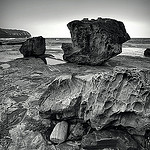
Verses 2 to 5 are dominated by imagery that describes God as a place of strength; as, that is, a physical structure:
“In You, Adonai, I shelter” (v. 2);
“Be my stronghold of rock,
a fort-house to rescue me” (v. 3);
“For You are my crag and my bastion” (v. 4);
“For You are my stronghold” (v. 5)
Indeed, with the very opening phrase, “in You”, the singer describes a comforting solidity that he hopes will encompass him. That stronghold is opposed, in imagery and in intent, by the “net” that the singer’s enemies have laid out for him (v. 5). Though the net, should it confine him, will prevent his mobility, still its composition –openwork– contrasts with the impenetrable rock of the shelter that the singer seeks in God. Moreover, the image of the shelter connotes no entrapment; rather, it is a protection that the singer can enter and, accordingly, depart. Its quality of solidity, then, unlike the net’s openwork, presents the singer no danger.
The second image pattern is introduced in verse 3 –that of another kind of physicality but one completely different in its nature from that of solid form: the phrase that opens verse 3, “Incline Your ear to me” (v. 3), attributes to God a bodily organ impossible to the image of inert rock. The six parts of the song that follow employ both of these seemingly incompatible image patterns –one, the metaphor of place or of a structure; the other, the metaphorical rendering of sensory abilities. But to the singer, no disparity exists. The two patterns are paired throughout the song; the singer creating harmony out of dissonance.
The second part of the song, verses 6 to 9, declares the singer’s gratitude to Adonai Whom, in verse 6, he names “God of truth”. A truth that is juxtaposed in verse 7 by the “lies” of the singer’s enemies. That the name,”God of truth”, precedes the enemies’ “vaporous lies”, effectively makes truth their reprimand. That same kind of juxtaposition occurs as well in the image of “hand”: in verse 6 the singer avows, “In Your hand I commend my spirit”; a trust he affirms in his declaration, “And You did not yield me to my enemy’s hand”, in verse 9. The implication is that the hand of God extends its justice to deflect the hand of the enemy, a meaning both the composition –the order or placement of the verses– and the imagery make clear. That the “ear” of God is imaged in the song’s first part, God’s “hand” in its second. gives a poignancy to the singer’s pleas for protection: the ear, the organ of hearing; the hand, of helping. The singer asserts that his trust in God has freed him, but not only from the enemies’ nets of entrapment –God’s “kindness”, knowing “the straits of [his] life” (v. 8), has “set [his] feet in a wide-open place” (v. 9). Thus the two image patterns, place and organic physicality, reconcile. “Straits” recalls the confinement of “net” that has gives way to “a wide-open place”; the singer’s “feet” stand on firmness but not within the solidity of the fort. Rather, his vision opens so that it sees only expanse.
The verbs, however, of the singer’s exultation are in the past tense — “set”, not “sit”. His expansive vision narrows in the song’s third section, verses 11 to 14, turning inward, seeing only its own dejected state. The change is jarring but unexplained. Between verse 9 and verse 10 is silence. The imagery of these verses describes the singer’s dejection; his actual physical organs become metaphors for his despair and sorrow. The verse opening this section of the song is
Grant me grace, Adonai, for I am distressed.
My eye is worn out in vexation,
my throat* and my belly.(v. 10)
The lines that follow his plea for grace, ending not until the close of verse 14, perceive only God’s apparent absence: the singer belies his freedom from “the straits of [his] life” that he proclaimed in verse 8; indeed his voice, in the song’s third part, issues from confinement itself.
The roots of the Hebrew words give the lines a complexity the English cannot: the word for “distress” has, in Hebrew, the connotation of “in a narrow place” (Heb: צ.ר.), thus making explicit the contrast to the “wide-open space” of the previous verse. And the Hebrew word for “worn-out” (עששה – עששית) suggests the darkening of an oil lamp; the sense of light dimming making more compelling his need for grace, Even the root of the Hebrew word for “grace” is similar to that of “to give a place to” (חנני – חניה).
The singer’s body itself exposes his despair –“my limbs are worn out”– as the vexation of verse 10 deepens to a profound debility:
For my life is exhausted in sorrow
and my years in sighing. (v. 11)
He gives no account of the nature or cause of his despair, although he does allude to his “crime”: “Through my crime my strength stumbles” (v. 11). Certainly verses 12 to 14 depict the “disgrace” his moral weakness has cost him in the regard of not only his enemies but neighbours and friends (v. 12). And while it is his enemies who have slandered him, who have plotted to take his life (v. 14), it is his own ebbing strength that he likens to a state of death:
Forgotten from the heart like the dead,
I become like a vessel lost. (v. 13)
The image of physicality –the heart– combined with that of place –a vessel– gives an emotional power to the verse that acts, in itself, as a shock of contrast to the singer’s weariness. Without sentimentality, that impact denies the singer’s contention that he is forgotten; the physicality of the imagery now encompassing the listener, the reader of the song, whose heart is touched.
In these verses of despair, but for the opening plea for grace, the singer makes no mention of God’s name. Though his cry to God reverberates, at least in the listener’s ear, the reader’s eye, nonetheless God is absent. Again, the singer does not explain whether the cause is his crime, one he thinks God cannot countenance, or whether his despair, and, with it, his very absenting of God, is itself the crime.
The last word of the song’s third section is “life” (v. 14). And although the singer fears the loss of his life, the very word itself leads wondrously into the fourth part of the song, into verses 15 to 19. These verses begin with a declaration of faith, as if the singer had, in the space between verse 14 and 15, in the space following the word “life”, freed himself from the “straits” imprisoning him:
As for me, I trust in You, O Adonai.
I say, ‘You are my God’. (v. 15)
The image pattern continues its description of organic physicality: the hand of God once again (as in verses 6 and 9) opposes the hand of the singer’s enemies, of his pursuers (v. 16). God is asked, “Shine Your face on Your servant” (v. 17) and the light emanating from the image cuts the shadows of the verses of despair. “Rescue me” of verse 17 echoes the plea for shelter of verse 2, the need of a “fort-house” of verse 3. But now, rather than a solid structure of shelter, what is asked for in verse 17 is intangible, the felt “kindness” of God. “My times are in Your hand” (v. 16): the imagery of shelter, of place, alters to that of time –of, that is, life.
The request for kindness in verse 17 recalls that of verse 8 –“Let me exult and rejoice in Your kindness” — and though the singer again alludes to his disgrace –“Adonai, let me not be shamed” (v. 18)– this time it is to repeat verse 2’s “let me never be shamed”. The disgrace that had previously humbled the singer he now transfers to his enemies, the death he had feared (v. 13) is to be theirs:
Let the wicked know shame,
and be stilled in Sheol. (v. 18)
The “lying lips” of his foes (v. 19) re-iterate their “vaporous lies” of verse 7, their “slander” of verse 14, but now the silence imposed upon them (v. 19) is the stillness of Sheol.
Verse 9 describes the singer’s feet fixed firmly upon a wide-open space. The remaining three parts of the song, consisting of verses 20 to 25, issues from that expanse –the singer’s vision is of the goodness of God, and, as a result, of his own safety. As the singer is uplifted, so his enemies are cast down.
Verses 20 and 21, the two verses of the song’s fifth part, unite the two image patterns, physicality or bodily organs, and structure or place:
How great Your goodness
that You hid for those who fear You.
You have wrought for those who shelter in You
before the eyes of humankind. (v. 20)
Conceal them in the hiding-place of Your presence
from the crookedness of man.
Hide them in Your shelter
from the quarrel of tongues. (v. 21)
“Shelter”, twice repeated, recalls that of verse 12; it is now, however, a ‘hiding-place” from crookedness and quarrels. It does not so much stand between those seeking God’s presence, and those who would assault them, as it transforms the seekers themselves: they are able to withstand those who would slander them, those who would assault them.
Verses 22 and 23, forming the song’s sixth section, resound verse 3: it had pictured the singer urgently calling on God –“Quick, save me”– asking God to bend toward him –“incline Your ear to me”. Verse 23 affirms that though “I had thought in my haste, ‘I am banished from before Your eyes’ “, nonetheless God’s ear had indeed heard, and God’s eye perceived, his distress.
It is this affirmation that closes the song. Verses 24 and 25 include the singer among all of God’s ‘faithful” (v. 24). He declares to them God’s “steadfastness” and justice. The ‘heart” of others that the singer feared had forgotten him, in verse 13, now forms part of his exhortation:
Be strong, and let your heart be firm,
all who hope in Adonai. (V. 25)
The two words, “heart” and “firm”, bring the two image patterns together inextricably: the firmness, the strength of God’s protection, God’s shelter, is the quality of the faithful heart.
—————————–————————————————————————————————————
* The translator, Robert Alter, explains that he has given an anatomical interpretation to the Hebrew nefesh, in keeping with “the physicality of the whole line”.
Chanukah has become an almost world-wide known holiday of lights. Just before the Christmas tree is set- the Jews whisk out their menorah and hallelujah! Candles, gifts and Chanukah “carols” are embraced and celebrated all over English speaking countries (and o’, of course- Israel too…).
What is the reason of celebration?
Many answers have been given. I would like to offer yet another insight, perhaps less illuminated.
Indeed, there is no way to belittle the miraculous victory of few Jewish men over an armed army of the Greek empire (!) but isn’t that the story of every holiday we celebrate? God has also smitten the mighty Egyptians and split the sea for His people. In a month and a half we’ll, God willing, celebrate the downfall of Haman and our salvation from the Persian Empire which held the flag of anti-Semitism in those days… and so on and so forth.
If we were appreciative enough, we would not have ceased to praise Hashem for his every-day miracles too. Those redundant wonders that we take for granted; babies that are born, the sun that keeps shining no matter how much we abuse the ozone, and all those fascinating achievements we encounter on an every-day basis usually without pausing to think of our source of inspiration. And how on earth are we not washed away from a planet which is covered and founded on two thirds water?!
Point is: there was something else in the miracle of Chanukah. A new idea for us to learn from and appreciate: the eight day oil miracle only happened a t t h e e n d. but the ongoing fighting (that went on for 20 years!) was a day to day lesson. The believing and God fearing Jews stood for what they saw right, against all odds. Day after day, year after year, battle after battle.
The fact that the human spirit can derive from his soul the spiritual power to hold up; the courage to fight for what one believes is right without knowing the end result, but doing what he feels he should nevertheless. That is the epitome of living up to your ideals. That is education for the generations after. If you do what you have to do. And if you do what is right- God will be at your side.
Song 30 presents a puzzle in its opening verse: “a song for the dedication of the Temple” (v. 1). For the Temple was built not by David but by his son, Solomon. It would seem, then, that David composed the song for the Temple that he envisioned, so that though he himself would not enter it, his words and melody would fill its space.
The verses following, 2 to 5, are composed of gratitude and exaltation: the singer affirms
Sing to Adonai, His devout ones,
And give thanks in recollection of His holiness. (v. 5)
This verse thus declares the purpose of the song: “to give thanks”. For, as verse 4 clarifies, the singer has escaped death and acknowledges Adonai to be his rescuer. The image in verse 2 – “for You have drawn me up” – has as its verb the Hebrew daloh (דִלִּיתָנִי), the verb used for the act of drawing water from a well. The singer has been rescued from a confinement, be it emotional or physical, one he could not have surmounted on his own. That it was a deliberate entrapment is suggested by the second line of the verse, “and You have not gladdened my enemies against me”; it appears he has been the victim of enmity. The metaphor, however, not only portrays the singer’s gratitude, it presents him, in the very image of being drawn out of a well, as the element of water. Thus the image itself describes his sense of being renewed, replenished, a sense that the next verse states straightforwardly as “I implored You, and You healed me” (v. 3). The two verbs in verse 2, “raise up” and “drawn up”, similar in meaning, join their subjects together in a parallel movement: “I will raise You up, Adonai, for You have drawn me up”. Nonetheless, the correspondence is not one between equals: the singer is lifted from an abyss to ground level; God, in contrast, is exalted, His sphere transcendent, from the earth to the heavens.
The image of confinement in verse 2 gains power as verse 4 elaborates upon its nature: the singer has been cast, presumably by his enemies, into Sheol, into the Pit of death. Thus the verses, 2 to 4, build up a tension that climaxes into ever-increasing sound, its full song expressing itself in verse 5, “Sing to Adonai”.
But even as the voices rise in unison, the singer’s call to the devout is itself a jarring note, interrupting the tone he has created in the previous verses. Those verses address God directly, intimately, as “You”. Verse 5, however, calling upon God’s “devout ones”, uses the possessive pronoun “His”, an apparent distancing between himself and God that the singer continues in verse 6:
For a moment, in His anger; life, in His will.
In the evening, [one[ will sleep, cry[ing]; but in the morning, a happy song.
The despair and joy the singer describes, then, is not his alone, but that of each of the devout, of all those who “recollect” that God’s will determines the whole of their lives, from sorrow, imaged as evening, to happiness, as morning.
Verses 7 and 8 return to the singer’s own moments of helplessness and elation: how, in his “serenity”, untroubled and naïve, he believed himself invulnerable – “Never will I stumble” (v. 7) – and how, living in God’s favour, he felt he stood “with the might of a mountain” (v. 8). Yet how, fearing God’s anger, as God hid His face from him, he “was utterly terrified” (v. 8). Once again, the singer addresses God directly; naming God as both the source of his strength and self-assurance and the cause of his poignant despair.
The singer’s gratitude for God’s life-giving mercy and healing (v. 2, 3,4), coupled with his vivid memory of his near-entrapment (v. 2 and 4), lead him, in verse 9, to use the present tense –“I appeal”—rather than the past tense, as he recounts his cries to and pleading with God; and to use the future tense – “I will call out” – as he makes clear his certainty that neither his appeals nor God’s answer will cease. Verse 10 repeats the arguments he used to convince God to rescue him and thus explains his certain trust:
What benefit [is there] in my blood, in my falling down to Sheol?
Can dust give thanks to You, can it narrate Your truth?
The words were uttered within the Sheol, death’s Pit (v. 4), but they could be the cry of all mortals, though the singer speaks, at least in verse 10, of only his own mortality. Certainly his self-bereavement is such that he imagines himself grieving, his garments those of “sackcloth”, his voice sounding not a song but a dirge (v. 12).
And yet, verse 12 transforms the poem into praisesong, the singer’s affirmation that God has turned the lament of grief “into ecstasy”, has undone his mourner’s cloth and “girdled” him, instead, “with gladness” (v. 12). Clad in joy, sure of God’s blessing, the singer acclaims Adonai; his heart singing the very song of praise that the poem’s 13 verses sound:
In response, [my] glory will sing to You, and will not be silent.
Adonai, my God, for all the world’s time I will give thanks to You. (v. 13)
Thus the song closes with the singer himself illustrating his description in verse 6 – his sackcloth has become the garment of a “moment”; his joy, the clothing of his “life”.
As the singer’s “lament” turns into praisesong, so do the meanings themselves of his images. “And will not be silent”, of verse 13’s song, echoes the image of death in verse 10 (“Can dust give thanks to You”), but as its absolute opposite: out of the stillness, out of the silence of Sheol and his release from its Pit, comes his song of exultation. The song’s closing words, “I will give thanks to You” (v. 13), are both the contrast to the dust’s voicelessness and the answer to his question – only life, not dust, can offer praise. His words of thanks repeat his counsel to the faithful in verse 5 –“give thanks in recollection of His holiness” – as, imagistically, the singer, “with the might of a mountain” (v. 8), fulfills his promise in the opening verse: “I will raise You up” (v. 2). That his acclamation will endure “for all the world’s time” (v. 13) rewords verse 6, “life, in His will”. Grateful for God’s help, he now sings morning’s “happy song” (v. 6).
Verse 11 asks God, “become my aid”. Certainly the “favour” he pleaded for has been granted. But the singer does not use the verb “to help” (as in, say, “Please help me”); rather, he employs the noun, making it the subject of the verb “to be” or “to become”. The opening of the same verse may very well explain his reasoning: “Hear, Adonai”. “Hear” is the first word of the Shema, the Jewish declaration of faith, but, in the Shema, it is the people Israel who is asked to listen. The words they are to listen to, however, name “Adonai, our God’, just as the singer, in verses 3 and 13, acknowledges “Adonai, my God”. The letters that form the root of the word “Adonai” spell out “I will be Who I will be” –spell out, that is, both being and becoming. It would seem, then, that, in composing his song –and composing it to be sung at the Temple’s dedication – the singer is suggesting that to “give thanks” is itself life-affirming, life-giving. Repeated three times in the song –verses 3, 10 and 13—the verb, the act of thanking, changes its subject, from the devout ones to the dust to the singer. As the poem ends, the voices of the devout and the singer together rise above the “silence” of the dust, their song sounding “for all the world’s time”.
Song 29 is a symphony of words: verses 1 to 9 compose a crescendo of sound; verses 10 and 11, a diminuendo rather than a resolution.
Verse 1 is an exhortation to the “children of the strong” to acknowledge the “glory and strength” of Adonai. Certainly the appellation could refer to a heavenly chorus, but, in the context of the song –set entirely in the natural world– it is more likely that they refer to the children of Israel or even the whole of humankind. The acknowledgement asked of them is much more than a token respect; verse 2 makes clear it is, in effect, a pledge of allegiance, the acclamation due to the ruler Who is God, whose strength is the source of their own: Ascribe to Adonai the glory due His name; Offer to Adonai the glory of His name; bow down to Adonai in holy splendour. (v. 2)
The verses that follow –3 to 9– are a description of God’s glory and strength. That the number of verses is 7 is appropriate — 7 signifies the physical world of nature. Each of the 7 verses begins with the phrase “The voice of Adonai” (but for verse 6 which is, however, a continuation of verse 5, as the joining “and” indicates). God’s voice is wordless. It sounds in thunder: The voice of Adonai is upon the waters; The voice of Adonai on the water, God of glory thunders, Adonai on great waters. (v. 3)
A sound that is echoed by the breaking and shattering cedars (v. 5); the shaking of the wilderness (v. 8); the birth-pangs of the deer (v. 9). The ear of the listener can imagine clashing chords — the impact of divine energy upon nature: The voice of Adonai in force; the voice of Adonai in splendour. (v. 4)
No distinction is made in the song between God’s strength and God’s glory or majesty. One quality is the complement of the other. God’s energy provokes both creative and destructive effects upon the physical world: the cedars of Lebanon, symbols of stability and stature, are broken apart, and yet the mountains of Lebanon skip like calves, dance like ”a young antelope” (v. 6). Again, no distinction is made between creative and destructive effects. Indeed, verse 9 combines both without comment: The voice of Adonai makes the deer give birth, and strips the forests bare. And in His sanctuary all speak glory. (v. 9)
Just as the voice of Adonai thunders (v. 3), so does it show its form in the shape of fire or lightening: The voice of Adonai hews them with flames of fire. (v. 7)
The verb “to hew” is commonly used to describe the cutting away or carving of a solid object, most usually a tree (probably why most translators prefer the verb “forks” or “divides”, rather than “hews”); however, the sense of “hews” recalls the cedars that were toppled in verse 5. Certainly the two images, thunder and fire, together describe a storm. Yet a literal interpretation — that the singer is attributing the storm occurring, perhaps even as he is composing the song, to divine power — while completely understandable, considers only one part of what the song depicts: verses 3 to 9 contain no human beings. The perception, rather, is solely of the physicality of the world. That is, it defines the two essential components of creation : making and un-making. Most likely, then, it is for this reason that the creative and destructive reactions in the natural world to divine energy are not differentiated, are not given a specific moral or ethical rationale.
Verse 10 thereby acts as a bridge between the verses depicting the natural world and the final verse, which introduces and wholly concerns the people Israel: Adonai sat in judgement, sending the Flood; and Adonai sits enthroned, king for all the world’s time. (v. 10)
The mention of the flood is the first indicator of a moral value in the song. It elevates the un-making, the destructive effect, depicted in the previous verses, while evoking the promise of re-making, of re-creation, that was the final outcome of the flood — God’s promise that never again will a deluge destroy the earth.
The final verse of the song, as if remembering that covenant, asks God to bless Israel with “wholeness”. That the singer asks first for the gift of strength for God’s people draws a circle; the song’s structure matches its final theme: the glory and strength of Adonai in verse 1 will now — so is the singer’s hope — be the attributes of His people: Adonai will give might to His nation. Adonai will bless His nation with wholeness. (v. 11)
That the final word in the song is “wholeness” suggests completion. The vision, however, cannot be of a finality. Rather, in its very connection to the song’s opening a new beginning is promised; the promise, that is, of a continual re-making.
—————————–————————————————————————————————-
Note: “Adonai” occurs 18 times in the song; the Hebrew for the number 18 and the Hebrew for “life” –“chai”– are the same. An appropriate repetition for a song depicting the created world. Because of the 18 repetitions, this Psalm is the paradigm for the 18 benedictions central to daily prayers.
 The opening line of the song juxtaposes the master or conductor of the musicians and the servant of God. This implied contrast contains no rebuke, no moral judgement. It simply denotes that even the most eminent among those who sing God’s praises are but servants of their divine ruler. However, the contrast that follows, that makes up the remainder of the song, is indeed a reprimand: the wicked man, choosing to be controlled by malevolency, is not only contrasted with but is defeated by God Whose governance extends throughout the earth.
 Song 35 is a wail more than a song, one rising out of the singer’s hurt and frustration at having been not only betrayed but vilified by the very friends he had supported and believed in. The idea inspiring the song is not difficult –the singer calls on God for support and rescue and asks, in closing, for God’s blessing upon himself and his supporters. But the structure which puts forth –indeed, animates– the idea is intricate and complicated, made up of intertwining images. The song is composed of a thrice-repeated pattern, each of the three repetitions formed of two distinct parts: the singer’s depiction of his enemies’ attempts to destroy him; followed, somewhat abruptly, by his praise of God Whom he extols as his rescuer and protector. Thus: the despair and pleas of verses 1 to 3 are followed by the praises of verses 9 and 10; of verses 11 to 17, by verse 18; of verses 19 to 26, by verses 27 and 28. And, remarkably, though the mood of the song is bitter and certainly not one of joy –the singer, after all, is seeking redress– nonetheless, the word most often repeated throughout the song is “rejoice” — the vengeance of his opponents ultimately transfigured into the exultation of the just.
 Song 34 is a praisesong that celebrates God Who offers shelter, not only to the holy ones but to the lowly and the broken-hearted. So that, while the song professes to be a means of teaching righteousness, it also emulates God by providing comfort. Though the 23 verses of the song divide easily into 2 parts, each part –especially the second– has within it several groupings, according to both tone and mood. The structure employs an alphabet form, but the 6th Hebrew letter, vav, is omitted. No explanation is given in the song for either the acrostic form or for the omission of vav, but, interestingly, it was on the 6th day, according to Genesis, that God created humankind. Could it be, then, that the entire poem –in its teachings about the relationship between God and humankind, and between one human and another– is, in effect, acting as the vav?
 Song 33 celebrates creation –the creative process, that is, worked by speech and eye; together comprising perception divinely inspired but possible to the human imagination. Appropriately, then, the song divides into 7 parts; though, interestingly, those parts involve different verses, depending upon whether the divisions are according to theme (to the qualities unique to divine and to human creativity) or to a description of God’s attributes alone. In either case, the division is into 7 parts. Dividing the song into those verses which give a particular word or phrase in praise of God, describing altogether 7 attributes, the result is: verses 4 and 5 (God’s virtues); 6 and 7 (God’s word); 8 to 11 (eternal God); 12 (God’s choice of Israel); 13 to 15 (all-seeing God); 16 and 17 (God’s majesty); 18 and 19 (God’s mercy to the faithful). In this division, the 7 attributes of God are framed by the opening verses (1 to 3) and the closing (20 to 22). Even the opening three verses, moreover, compose a 7-fold march of verbs: “sing” and “praise” (v. 1); “acclaim” and “hymn” (v. 2); “sing”, “play”, and “shout” (v. 3) –each verb directing the choir to joyously proclaim Adonai. Number seven in Jewish mystics symbolizes ‘Nature’.

 Thematically Song 31 divides into 7 parts –verses 2 to 5; 6 to 9; 10 to 14; 15 to 19; 20 and 21; 22 and 23; 24 and 25. Two seemingly disparate image patterns intersect these divisions; coming together, effortlessly, in the lines of resolve and stalwartness.