Laws of hospitality – Halifax Shalom Magazine, May 5773


Wherever and whenever, Jews were always known to be at the head spear with the Mitzvah of Hospitality. Not only as a one-time act, but also with continuous functioning systems to welcome any guest in town, and attend to his needs. Even more so if the newcomers expressed their interest in linking on to the local Jewish community.

The main obstacles in fulfilling the commandment of hospitality stem from the cultural gap and the different purposes of the two sides of this ‘meeting’, the host and the guest.

Baruch HaShem, we are fortunate to have a large group of newcomers in town. Therefore I think it is a good time to shake the dust from this Mitzvah, to make sure we’re doing it properly according to the Jewish Hallacha and with the right adjustments to our unique time and place.

A practical guide for hospitality, Atlantic Canada, 5773 from the creation of the world:

  • Who is considered a guest, for the purpose of the Mitzvah?
    Initially, the purpose of the Mitzvah was to tend for poor people that needed “bread to eat and a bed to lay their heads on” (Shulchan Aruch, Or”ch, 333,1). Specifically here, in our case and in our community, the support needed is more of a mental kind. Whereas a person might be settled with assets, he can still be socially and mentally poor. As Maimonides says (Quoting Aristotle) ‘humans are social and political creatures’. As such, they have also social and political needs. These needs too, need attendance.
  • Shouldn’t they do the ‘first step’, show themselves in Shul etc. and then we will invite them over?
    “They” already have tried to approach you more than once in the last three years. As mentioned in the opening, there is a bit of a cultural gap, so for some reasons the ‘first approaches’ were missed. The good news is that it is yet not too late. Many of who I occasionally met, are still eager to get to know the local Jewish community.
    Regardless to the above, I would like to refer also to our forefather Avraham (B’reshit 18,1-8)        : Three days after Avraham was circumcised (at the age of 99), sick and hurt, he was slowly healing from the operation. His home back then was in a hot desert. Avraham was sitting at the entrance of his tent catching the breeze when he saw three people wandering around. The Torah tells us in detail how Avraham runs toward his treasure; his guests. Forgetting his poor health condition, he runs and together with his wife Sarah, they prepare a feast fit for kings… Sarah and Avraham made sure their guest feel welcomed, without waiting for any first step. They are our example.
  • I tried to talk, invite, encourage and more, but it’s stuck. Maybe they’re just not interested!? It is not proper for me to ‘overdo’.
    They are interested. Ask your parents / grandparents, how they felt when they immigrated to this foreign country! For most of the newcomers that we are blessed with here, it is already the second time (Soviet union-Israel-Canada) they need to adjust to: Language, culture, economy, employer-employee relations, schools..
    Interesting point: when Eliezer, Avraham’s servant is sent to choose a bride for his master’s son, Yitzchak, one might have assumed he would look for someone in that pagan world who made the extra step like Avraham and his household; someone who would realize there must be something very wrong, even corrupt in worshipping idols! But no. That is not what Eliezer seeks for Avraham’s son. He knows to look for something characteristically basic in human behaviour. He seeks for hospitality. Ideas and ideology can be taught, but good traits are harder to find and to become intrinsic to one’s nature. Rivka is recognized to be suitable for the match, for being a Jewish mother, Foremother of Israel, wife to Yitschak, because she offers herself to quench the thirst of Eliezer and of his camels. More than that, she performs this noble yet exhausting deed with a smiling face (B’reshit 24). Rivka overdid – we can also do the same.
  • Few practical steps to start with:
    • There is nothing more Jewish than   inviting a guest for a Shabbat meal. Whereas Shul is like a semi Beth Mikdash, a table with guests is considered as the altar itself (Babylonian Talmud Hagiga 27,2).
    • Don’t ask about: reasons for immigrating, working place and whether he’s here permanently or just on the way to Toronto. It might not be easy for him to talk about it (Avot, Ethics of our fathers 2,4).
    • Don’t be judgmental. You are there to help a Jew at need. The supreme Judge of the universe, God Himself, is the only One responsible for measuring people.
    • Don’t patronize. Don’t shoot advice and suggestions at the newcomer, before listening to his real needs. They know how they want to live their lives and how to practice their Judaism. If you are eager to pass on information, start with technical issues: Where is best place to shop, important phone numbers, family doctor, Avia’s Gma”ch of free furniture etc. (Isaiah 42,1-3).
    • Everything you do – do with a smile! (Babylonian Talmud, Baba Metzia 59,2)
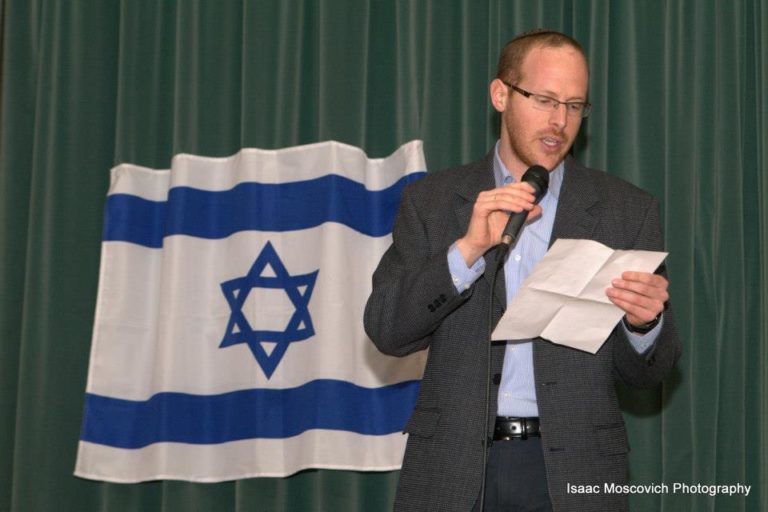
 

Israel Independence day – Atzmaut 5773, celebration at the Beth Israel Synagogue (Opening speech)

May 14th 1948 – declaration of the establishment of the State of Israel

.. “by virtue of our natural and historic right and on the strength of the resolution of the United Nations General Assembly” ….

David Ben Gurion – the first to be prime minister of Israel

..declares “the establishment of a Jewish state in Eretz Israel, to be known as the State of Israel”..

Today is a Holiday for us.Rabbi Maccabi Yom HaAtzmaut 5773

We thank the Creator of the world, and celebrate the opportunity, to stand on our own two feet, after two thousand years of forced exile.

We celebrate the fact that Jewish blood is not worthless anymore,

Instead, with Gods help, we have the strongest, and the  most ethical army in the world that defends Jews worldwide.

This makes sure that every drop of blood of the (23,085) twenty three thousand and eighty five fallen soldiers,  and of the(2,493) two thousand four hundred and ninety three  Jewish victims of terror attacks is retaliated.

All of these victims are not in vain,

they are a cornerstone to a state  that –

despite the criticism –  teaches the world how to sanctify HaShem with life, and that sings ‘hope’ to the world.

We are proud, that our homeland consists of:

A Righteous society with institutions built of social justice,

Jewish education systems that combine excellence in Torah studies and advanced science,

Transformation of an ancient forgotten language to a modern one,

A place that despite the absence of natural resources and against all odds – continues to flourish, stand in its own right, and contribute to the rest of the world its ideals of morals, humanity and lends an assisting hand in times of peril!!!

חברים

We celebrate Israel,

The one and only place, that although we don’t live in it – it is ours, and we really belong to it!

חג עצמאות שמח

Psalm 5:8 Being close to the Lord

“וַאֲנִי בְּרֹב חַסְדְּךָ אָבוֹא בֵיתֶךָ אֶשְׁתַּחֲוֶה אֶל הֵיכַל קָדְשְׁךָ בְּיִרְאָתֶךָ”

“But I, with Your great loving-kindness, shall enter Your House; I shall prostrate myself toward Your Holy Temple in the fear of You.”

What is my biggest wish? What is the best grace HaShem is spreading over me?, says King David – it is being close to Him. It is an Irrational thing for a limited human (120 years max on earth..) to even talk to the Lord, what does it mean to be in His holy house? Can HaShem be limited to Time and/or Place?

Indeed, that is one of the gifts that we won’t understand how and why He did, but HaShem concealed Himself when creating our world, letting us the opportunity (therefore obligation) to communicate with Him.
This also explains a bit the human urge for chasing eternity. From the first days of the people we try to overcome our ‘time and place limits’, embalm the dead, take pictures etc.
It is a natural need to get closer to the Lord.

Question: What does it mean that He limited Himself in time and place?

Answer: Our world was created in a way there are differences between every one thing to another. No two people are identical, not even two drops are the same. Even the same drop differs itself when you look at it in two different times – first it’s time period has changed, second it is probably in a different place, something has been changed in this same drop. When you entered this room you were 30 minutes different than now.

Same way, there are differences in ‘holiness’ between time to time, place to place and one person to another.

Psalm 5:7 Destroy the wicked

“תְּאַבֵּד דֹּבְרֵי כָזָב אִישׁ דָּמִים וּמִרְמָה יְתָעֵב יְהֹוָה”

“You destroy speakers of lies; the Lord abhors a man of blood and deceit.”

David asks HaShem to destroy all the hated wicked.

It raises a question about King David’s personality.
Absalom, Saul, Shimee and others, many cases in which we have seen King David as forgiving person.His request now, of destroying the wicked is not the David we accustomed to know in the stories that appear in the Bible.

The general difference of David’s behavior between the cases, seems to be whether it was “family” or someone “outside of the family”.

Whenever evil deed is done by Israeli people, David is closer to forgive, even turning a blind eye..
When the case is of someone else that is ‘a man of blood and deceit’, David asks HaShem to act in a strictly justice manner. “You destroy speakers of lies”.

Question: Doesn’t it encourage favoritism? 

Answer: In short: I would be disappointed if you treated the same way, your child / sister, as you treated a neighbor who harmed you.  We won’t encourage favoritism always, but beside the natural part of it, there is also moral room for it.

Psalm 5:5 G-d hate the wickedness

“כִּי לֹא אֵל חָפֵץ רֶשַׁע אָתָּה לֹא יְגֻרְךָ רָע”

“For You are not a God Who desires wickedness; evil does not abide with You”

The consistent question of the existent and so often also the dominion of evil in the world, is the source of this verse.

Yes, the evil exist and might prosper. But You – G-d hate the wickedness, the Evil does not abide with You.

What room is therefore for the evil in the world? Answer- To allow free will! By all means, it doesn’t indicates that HaShem like the wickedness.
Thank goodness, nowadays we’re accustomed to think about free will as a basic and reasonable thing every person is eligible to.  A deeper view, might question the mere possibility of doing anything against the Will / commandment of the Lord.

Meaning – G-d created the world and consistently maintains it, without Him nothing would exist for even the slightest shred of a second.
If that so, how is it possible that we (Humans) can do anything that contradicts His Will? Is He providing us with the power to disobey Him??  The answer again,is yes. For some reason, HaShem created a world that one of it’s fundamentals is ‘free will’, so we can even turn against our own Creator. All of that in order for us, to also choose (/coronate) Him as our King.

Psalm 5:6 The wicked don’t have the ability to stand in-front of the Lord

“לֹא יִתְיַצְּבוּ הוֹלְלִים לְנֶגֶד עֵינֶיךָ שָֹנֵאתָ כָּל פֹּעֲלֵי אָוֶן”

“Confused people shall not stand before Your eyes; You hate all workers of iniquity”

I find two interesting things in this verse:

1) Once again, David describes good and bad, happiness and sorrow through ‘stability’. Here, the wicked ‘shall not stand’ before your eyes (in Hebrew “Lo Yitya-tzvu” can also be translated as ‘won’t be stable’). Bad equals un-stable.

2) Second, Hatred, which we automatically flinch from, is sometimes acceptable.
Hate for the essence of evilness and for hatred itself, is surly a right thing. This is revealing the good and righteous by taking of the wrong.

Nevertheless, I still debate though, if to learn from this verse (and few others), is the right thing/acceptable to hate every bad thing and every wrong doing.  Or is it a ‘too severe reaction’. In that case, what king David is referring the hate to, in the current verse, is that HaShem is the one that hates this kind of wrongness. Till we ‘get to His level’ of perfect definition, let us hate only at extreme circumstances.

Psalm 5:4 Can’t start the day before praying to G-d

“יְהֹוָה בֹּקֶר תִּשְׁמַע קוֹלִי בֹּקֶר אֶעֱרָךְ לְךָ וַאֲצַפֶּה”

“O Lord, in the morning You shall hearken to my voice; in the morning I shall arrange to You, and I shall look forward

Some people can’t start their day without cup of coffee and newspaper. For others it is a shower or some exercise.

First thing the King of Israel, is a prayer to HaShem. The first thing I do upon my getting up, says David, is to talk to you.  Not demanding, not because I’m certain you will answer my prayers positively – Just for the sake of talking to HaShem. And thus, pray and expect it / look forward for You to answer my prayers.

Psalm 5:3 Recognizing G-d as my King, saves me from the pit of despair

“הַקְשִׁיבָה לְקוֹל שַׁוְעִי מַלְכִּי וֵאלֹהָי כִּי אֵלֶיךָ אֶתְפַּלָּל”

“Hearken to the voice of my cry, my King and my God, for I will pray to You.”

The belief and knowledge that you are my King and Lord (in this verse, the Hebrew meaning for the name of G-d is ‘the One who provides all abilities’), strengthen my spirit and prevents me from falling toward the pit of despair.

Therefore, I pray to You at any time, convenient occasions and hard ones.

Question: What does G-d help in moments of angst?

Answer: Many times ‘in order’ for a person to fall into despair, is when being ‘over responsible’. I mean, that while doing everything one can do to achieve a goal, one sometimes thinks that everything should be under his control, not leaving room for HaShem..not praying.

Of course, we must do all efforts we can to achieve our purposes. Just let us not forget He is the one providing us the ability to do anything.

This way, if we fail, it might just be because G-d didn’t want it to happen this time or that way.
This way, we’re never alone, never-mind what we do, struggle for. Nothing is worthless (G-d is also invested in it..), nothing is impossible (He is creator of abilities). We are never alone.

Question: What does it mean that in Hebrew the meaning of G-d in this verse is “the One who provides all abilities”?

Answer: Unlike English or any other language, in Hebrew G-d has many names. These are the ways we refer to Him.

For example, sometimes we stand in-front if the Judge of the Universe (Like in Rosh HaShana, the Jewish new year). Sometimes we refer to Him as our Father, as the verse says “My firstborn Israel”. Sometimes as a warrior, an old wise man, etc….

The simple reason for that is, we, humans cannot define the Creator who made us. It is something beyond our understanding. Like HaShem tells Moshe: “And He said, “You will not be able to see My face, for man shall not see Me and live.”.    Still we want and ordered to talk to Him and about Him.. So we refer to The One each time in the way we “meet” Him in the specific time, place and occasion we are standing at.  This part of Theological study is sometimes called “Kaballah”

Psalm 5:2 Prayer of the heart

“אֲמָרַי הַאֲזִינָה  יְהֹוָה בִּינָה הֲגִיגִי”

“Give ear to my words, O Lord; consider my meditation”

Times in which our heart, dreams and vision is more advanced, even more than the possibly of our words to describe it.

HaShem, please understand the quiet praises of my heart, although I don’t have the ability to form them into words, for they are powerful.

Psalm 5:1 Always sing, for there is a Conductor to the world

“לַמְנַצֵּחַ אֶל הַנְּחִילוֹת מִזְמוֹר לְדָוִד”

“To the conductor, on nehiloth, a song of David.”

The easy meaning of “Nehilot” is an instrument, used during the Levites singing’s in the Temple.

Another explanation is ‘swarms’. The explanation of the verse will then be as follows:

To the Conductor.. of the world – HaShem, conductor of the whole universe. I sing to you, feeling confident, even when armies of my enemies are swarming at me to attack.